Guaranteed Income
Recovering Wages and Wealth
05. 05. 2026
What We Deserve in the Age of AI
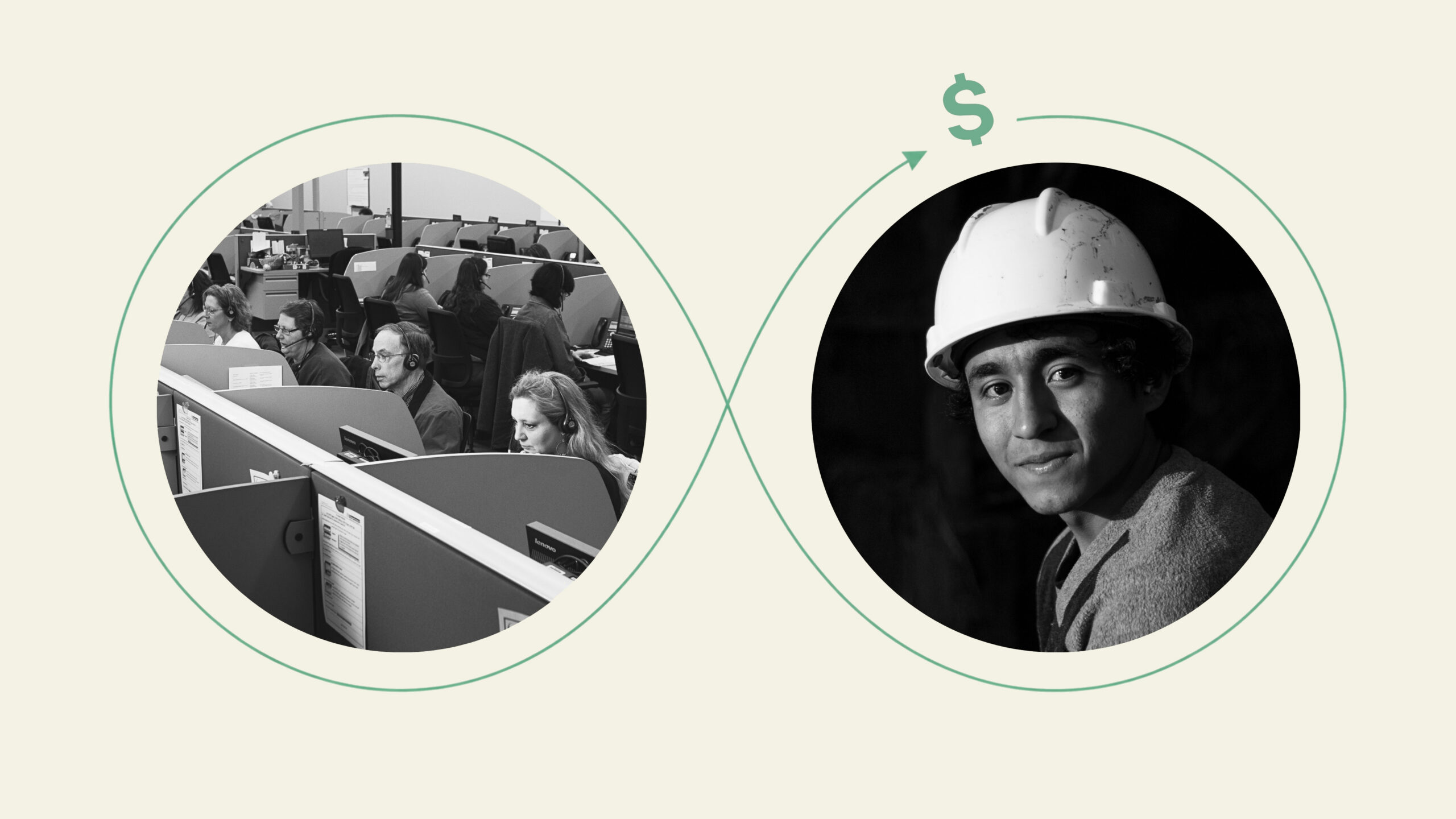
I’ve lived both sides of America’s deservingness story.
My mom worked essential jobs and raised three children by herself. Yet, we struggled for even basic stability — because work never paid what we deserved. We moved between around thirty homes across the Phoenix Valley before I turned thirteen: random Craigslist roommates, motels, parking lots. For a while, our biggest dream was to get off the waiting list for our local homeless shelter.
My mom’s boyfriend Joe — the closest thing I have to a father — spent years in manufacturing and warehouse work until those jobs vanished in the 2008 recession. He rebuilt. He became a manager at a call center, where he met my mom.
“In America, deservingness is the battleground.”
Then those jobs were automated. In 2024, the AI that my mom and Joe helped train replaced them. They lost their careers.
Both of them did everything their country asked them to do. And the system abandoned them the moment they were no longer profitable. Over and over again.
Then, I went to Yale on a full scholarship — a kid from Arizona, first in my family to go to college. Then, I earned a Rhodes Scholarship to Oxford.
With that opportunity, I chose to study the structures behind my life: why our economy makes promises it refuses to keep, and why the people who sustain our world receive the least from it. I earned a PhD in Public Policy and Economics. My doctoral research examined the idea of meritocracy — the story we tell about who deserves what and why.
It took earning a PhD to know what I always felt: In America, deservingness is the battleground. We judge every policy — if not every single thing that happens to every single person — by whether we believe people got what they deserve.
My mom and Joe are not exceptions. Our country disrespects people like them because of the falsehoods we tell ourselves about them. We know that story: that working people are “unskilled.” They are “unproductive.” They are “non-essential.” They are “disposable.” They are “replaceable.” They are “takers.”
Meanwhile, the story now being told about me is that I am exceptional. That I am going to change the world. That I am an example of the opportunity that America offers to all people, if only they put the effort in.
Neither story is true.
The truth is working people hold the world together. And working people deserve better.
***
I am working to build an America that respects the people who make it all possible.
As a Fellow at the Economic Security Project, I am designing worker protections against AI and automation — in collaboration with rideshare drivers, who are responding to the emergence of self-driving cars. And I am supporting worker-led campaigns for living wages across the country. Because one job should be enough.
The amount that working people have lost —and the amount we are trying to reclaim— is massive. Since 1975, by RAND’s accounting, policy choices have redirected $79 trillion in income growth away from 90% of American workers to the top 10%. Over the course of a career, that compounds to nearly $1 million per worker.(1) That number is real hurt. For my family, it is the retirement my mom and Joe will never have. It is years of worry that could have been years of living. It is teeth Joe could have kept.
It is the erosion of the belief that their work was essential. It is the collapse of the belief that their country is theirs.
“So the money we fight for in a world of automation will not be charity. It will not feel like a handout. It will be payment for the world we built.”
For my parents’ generation, these losses accumulated over decades. For our generations, the losses are just beginning to compound. We work for wages that have not been livable for decades. We try to build careers and savings before the next recession destroys them. We pay the price of life-long debt for skills that our economy may never reward.
We all began to accept that work in America will not be part of a good life. Work will be a life sentence.
Now, a new era of automation is here. Artificial intelligence could change the nature of work. It could mean older Americans lose the careers they built over decades. It could mean younger Americans’ careers end before they even begin. It could mean even a bad job is not guaranteed.
In that world, we may only get to survive if the government and corporations grant us money to live on. But that is not a world to wish for.
We must not lose the truth. Even if the nature of work changes, what we deserve will not. Essential human labor will still be essential. We will still hold the world together in the way only living beings can. And there is an unpaid debt already. We built the world that makes new technology possible. We deserve the benefits.
So the money we fight for in a world of automation will not be charity. It will not be a handout. It will be repayment for the world we built.
It will be money we should have had all along.
Why NowI. Why Now
Our Broken and Still Breaking Economy
Essential workers have been underpaid for decades. For generations, people have done everything this country asked of them. They have built our roads and warehouses, staffed our hospitals and schools, cared for children and elders, kept food on our plates and the lights on. They have juggled multiple jobs, taken pride in what they contribute, and held families and communities together. People do the essential work that we all need, and most have little to show for it.
This is true both inside and outside of formal employment. Jobs often pay less than it takes to survive, and millions of people — most of them women, many of them people of color — parent children, care for elders, and support people with disabilities, which our systems often do not recognize and reward as “work” at all. That $79 trillion shift translates into hundreds of thousands of dollars in lost income for a typical person over the course of their working life.(2) That missing income becomes the home never bought, the savings never built, the years spent scrambling instead of secure.
These losses are not confined to older workers looking back on what might have been. For younger people, loss defines both the present and the future. Millennials entered an economy where starting wages were low and basic needs were more expensive than ever. Conditions have only worsened for Gen Z and Gen Alpha. Today, half of all workers earn under $25 an hour(3) — below what the MIT Living Wage Calculator shows families need to cover basic expenses in most of the country. The American Dream has become a nightmare.
AI is arriving in an economy that is failing people. And the threat is that it can make existing problems worse.(4)
Cash as a Solution — or Surrender
The common answer to these challenges is cash. Automation reshapes human labor; cash payments step in.
The idea itself is not new. Martin Luther King called for a guaranteed income in 1967. (5) Richard Nixon’s guaranteed income bill passed the House in 1970. (6) The scale is new. AI forces the country to answer what it has been able to defer for half a century: what do we owe people whose work built the economy that is now reshaping itself without them?
But even that answer splits in two directions.
How we design cash policy reflects a deeper choice about how we relate to technology itself. In both versions, innovation generates the wealth that funds cash. The difference is what that cash means — and what innovation does to us. One version imagines cash as a platform: money that frees people to grow, take risks, and choose how they contribute — because their basic stability is no longer in question. In this world, innovation serves people. Another version treats cash as a payoff for becoming irrelevant: a small, regular check to those pushed to the margins, while the gains of technological change flow to the people who own the newest technology. In that world, innovation hurts people. Cash is either empowerment or it’s a write-off.
Which path we take will be decided by the story we tell about what cash is and what it is for. Program design alone will not determine it. Is it charity for people the economy left behind? Is it a consolation prize for those on the losing end of history? Or is it, at least in part, a recognition of value people have already created and were never fully paid for—a step toward restoring what has been taken and rebuilding an economy that works for all?
When framed and delivered well, cash can create the conditions for agency and self-advancement: giving people the stability and flexibility to change jobs, pursue training, care for family members, start businesses, or invest in their own productivity. When framed wrong, it risks signaling retreat — a concession that society no longer expects people’s contribution. The difference lies not in the dollars themselves, but in the meaning attached to them.
Cash is most powerful when it helps fix work — when it changes the conditions under which people labor, not when it replaces labor itself. The case for cash rests on two forms of power that operate simultaneously.
The first is material. Cash gives workers a base to negotiate from. A person with an income floor can leave an exploitative job, hold out for better conditions, absorb the risk of a career transition, or invest in training that a bare survival budget would never allow. This is bargaining power in its most concrete form: the ability to say no to bad work because the alternative is no longer destitution.
The second is narrative. When cash is framed as recognition of contribution — as Recovered Wages — it does what money alone cannot. It tells workers that their labor was essential, that the value of their work has not been recognized, and that recovery is possible. AI puts this narrative under direct pressure. As automation extends from manual labor into cognitive and service work, the experience of contribution, the thing the frame depends on, becomes harder for more people to claim in real time. That makes it urgent to name contribution that has already occurred before the terms shift further. Material power changes what people can do. Narrative power changes what people believe they deserve. Both are required. Cash without the story is relief that can be quietly revoked. The story without cash is recognition that cannot pay the rent. Recovered Wages holds these together: a frame in which cash is the instrument and dignity is the design principle.
Why the Story Matters as Much as the Money
This memo focuses on one component of that larger debate: how people interpret, receive, and are affected by cash grants as a matter of framing and delivery. The same cash can land very differently depending on whether it is presented as charitable assistance or as money earned and owed. That difference shapes whether people claim the benefit with pride or accept it with a sense of shame for being left behind.
“Meritocratic language dominates how Americans judge fairness. We can use truthful accounts of contribution to expand who counts as deserving.”
American history offers a clear lesson here. The most durable and widely supported economic programs are those people experience as earned through contribution. Social Security did not become politically untouchable because it was generous or universal; it endured because workers understood it as theirs — the result of visible contributions made over time. That sense of earned ownership shaped how the benefit was received, defended, and protected across generations. As cash policy expands in response to economic insecurity and technological change, this earned-benefit tradition offers an essential guide for how cash grants might be framed, delivered, and understood.
People respond to the agency frame. Research synthesized in the Economic Security Project’s Narrative Window of Opportunity shows that across race, geography, and political identity, the most resonant economic messages affirm self-advancement, freedom, and the dignity of hard work — paid or unpaid.(7) Narratives centered on rest or withdrawal underperform. People want policies that help them move forward — to contribute, to build, and to create a better future for themselves and their families.
Cash pilots demonstrate that cash can be stabilizing, relieving, and life-changing. Recipients describe real gains in well-being and agency. The evidence base has matured. A 2024 synthesis of thirteen completed pilots found that cash increased employment, improved financial stability, and produced measurable gains for children.(8) Design and framing still matter. They determine whether those gains are sustained when payments end.(9) The same pilots reveal a persistent challenge: even in the largest U.S. trial, where cash improved well-being and gave people more control over their time, many recipients still experienced a quiet stigma in receiving help, a sense that assistance signals personal failure or diminished worth.(10) As AI pushes cash policy onto the national stage, that stigma becomes a serious political and narrative liability. Without a stronger frame, cash risks being understood as the signal of loss — the payout people receive once they no longer matter. Yet stigma and political durability are not separate problems. A frame that reduces shame produces recipients willing to claim benefits publicly and defend them politically, which normalizes the program, which further erodes stigma. Getting the story right is how policy becomes permanent.
The polling shows it. When asked how government should respond to job loss due to AI, Americans chose new jobs over direct cash by more than three to one.(11) Cash framed as payment for becoming obsolete meets resistance. But the same people who reject that framing report concern about wages that do not keep up, about young people locked out of work before they begin, about an economy that feels rigged against them. The resistance is not to cash. It is to the story.
The case for direct cash has evidence, pilots, and growing momentum. What it lacks is a convincing answer to the deservingness question — a story about why people are owed this money that can survive contact with the deepest moral intuitions in American political culture.
“People’s work built this country, sustained it through comfort and crisis, and still makes everyday life possible — even as the rewards went somewhere else.”
This is the oldest fight in American politics: who deserves what, and who decides. Deservingness is how we determine who belongs — and which policies survive. We have to bring a deservingness story to a deservingness fight. Meritocratic language dominates how Americans judge fairness. We can use truthful accounts of contribution to expand who counts as deserving. Or we can cede that ground and let distorted meritocracy keep shrinking the circle. Those are the only two options.
The path forward starts with recognition: naming the work that actually holds this country together, and telling the truth about who does it and what they deserve.
In an economy where AI changes work, cash grants with the wrong story tell people they are less worthy. Cash, in that story, becomes a sign of irrelevance rather than a platform for growth. Avoiding that outcome requires more than money. It requires telling the truth alongside the cash we give: people built our country and people deserve more from it.
In what follows, I make the case for one set of such frames: Recovered Wages & Wealth. Recovered Wages treats certain forms of cash, such as cash grants, as a partial return for unpaid or underpaid work, whether in low-wage jobs or essential care labor long excluded from recognition. Recovered Wealth names what that underpayment compounds into: the savings never built, the homes never bought, the stability never secured. The economy that produced artificial intelligence — and the wealth it is generating — was built on the labor of people who were never fully paid for building it. Together, these frames name both the cause and its consequence.
Deserving Cash: Recovered Wages & WealthII. Deserving Cash: Recovered Wages & Wealth
Recovered Wages: Naming the Debt
Recovered Wages begins with a simple truth: most people have contributed far more value to their communities and to the economy than they were ever paid — and they know it. Their jobs, their caregiving, and their contributions to families and neighborhoods have been indispensable, even as their paychecks and public recognition have failed to reflect that reality. In a moment when meritocratic language still shapes how people judge fairness and policy, Recovered Wages works within that moral frame — using truthful evidence about contribution to expand who is recognized, rather than waiting for an entirely new narrative to emerge.
Recovered Wages makes a claim: cash grants are a partial return of value people already created, are owed, and never received. That’s not charity. It’s recognition. It’s respect. This is not a proposal for a new means test. Nearly everyone who is insecure has worked — in formal jobs, informal labor, or caregiving roles — that were underpaid or unrecognized. That is the grand unifier. In this sense, Recovered Wages is not about redefining who counts as deserving, but about finally recognizing who always has.
Older and mid-career workers have spent decades contributing while falling further behind. For a typical full-time worker today, wage suppression translates into roughly $27,000 in lost income each year.(12) Over a full career, that loss approaches $1 million per worker — the per-worker share of the $79 trillion redirected from the bottom 90 percent of American workers to the top 10 percent since 1975.(13)
The losses are not only behind us. Millennials have less than their parents had at the same age. Gen Z is paying down debt for skills the economy may not reward. Gen Alpha is being asked what they want to be in the future, when the very nature of work in that future is uncertain. Work has been failing people for decades, and it is failing people now.
These losses are the foundation that AI is arriving on top of.
This narrative works because it articulates what people know and feel: people’s work built this country, sustains it now, and still makes everyday life possible — even as the rewards go elsewhere. That urgency deepens as AI automates the work people hold now and closes off the work young people will never get to do.
These frames name what was taken — and what can still be built. By affirming that people have earned the cash they receive, we support people using that cash for forward motion — to take risks, make transitions, and invest in themselves with pride.
Recovered Wealth: What Was Never Allowed to Grow
Recovered Wages speaks to underpayment. Recovered Wealth names what that underpayment compounds into. A dollar never received is a dollar that cannot be saved, invested, or used to build a stable future. Lost wages become lost wealth — lost homeownership, lost savings, lost stability.
For younger workers, this is not an abstract trend but the defining feature of their economic lives. A Millennial who started working in 2010 is on track to lose roughly $700,000 in wages and wealth over the first twenty years of their career. For a member of Gen Z entering the workforce in 2025, that figure approaches $900,000 before they reach middle age. Gen Alpha is expected to fare even worse.(14)
And those missing earnings compound quickly. Missing income is also missing wealth — savings that were never built, returns that never had a chance to grow. Based on actual historical market returns over the period RAND measures, a full-career worker’s lost investment returns alone exceed $300,000. For younger workers, the compounding has only begun — and the losses will grow with every year they remain underpaid. For Black, Brown, and immigrant families, who already face large racial wealth gaps, these missing dollars widen disparities even further.
These losses do not simply reflect wages that were too low. They reflect wealth that was actively prevented from forming. For decades, the pathways through which American families built economic foundations — homeownership, education, savings — have been obstructed and converted into sites of extraction. Redlining locked Black and Brown families out of the single largest wealth-building mechanism in American history. Predatory lending stripped equity from the communities that were finally allowed in. The cost of higher education, once a public investment in upward mobility, has been offloaded onto students themselves, producing over $1.7 trillion in student loan debt that functions less as an investment than as a drag on an entire generation’s capacity to save, buy homes, or start families.(15) Housing costs have outpaced wages so far that homeownership rates among adults under 35 have fallen to historic lows.(16) The case for reparations, as scholars and advocates have documented, is one clear accounting of how wealth was not merely withheld but extracted — from enslaved labor, from segregated housing markets, from communities whose value was taken and whose claims were denied. What younger generations face today is the compounded result of these choices: wealth that was hoarded at the top and never allowed to accumulate at the core.
The compounding effects are visible in nearly every marker of economic adulthood. The median age of first-time homebuyers has risen to the mid-30s — a historic high.(17) Young adults are living with parents at rates not seen since the Great Depression.(18) Birth rates have fallen to historic lows, driven in part by economic insecurity leading to the inability to afford children.(19) These outcomes are what happens when wages are too low to save, costs too high to manage, and wealth-building pathways close before this generation can reach them. Each year of delayed homeownership, deferred savings, or postponed family formation represents a compounding loss, wealth that will never catch up because the foundation was never laid. AI now threatens to compound these losses by eliminating the entry-level work through which younger workers might have built earnings, savings, and a future. Recovered Wealth names this cascading deficit and insists it was produced by identifiable choices, not by generational failure.
Recovered Wealth reframes policies such as baby bonds or other basic capital grants as tools for rebuilding the foundation earlier generations received — not as gifts, but as partial restoration of what was taken. It names what they already feel: that the rules changed before they arrived, that the foundation earlier generations enjoyed was pulled away, and that the pathways to stability and prosperity have narrowed to the point of disappearing.
Restoring the Sense That a Good Life Is Possible
Recovered Wages & Wealth are about more than returning income or rebuilding assets. They are about restoring a sense of hope — the belief that our work can lead to stability, growth, and a better future.
Across generations, Americans increasingly feel that opportunity has narrowed. Polling shows that young people report the lowest optimism ever recorded, and older Americans believe their children will be worse off than they were. This pessimism crosses age, race, and geography; it is felt by people who have already been harmed and by those who fear they will be next.
These “recovered” frames offer one way to push against that drift. They point to what was taken — underpaid labor, lost earnings, missing foundations — and point out what can still be restored. They say: you deserve more and solutions are still possible.
Deservingness, Durability, and Political PowerIII. Deservingness, Durability, and Political Power
Deservingness: The American Battleground
To understand why Recovered Wages & Wealth resonate, start with the stories we tell about work, worth, and who deserves support.
In America, deservingness is the battleground. We judge every policy — if not every single thing that happens to every single person — by whether we believe people got what they deserve. Programs framed as “assistance” often collide with one of the most enduring American beliefs: that people should work for what they get and only get what they deserve.
This dynamic helps explain why universal cash programs often struggle. A benefit given to everyone can feel detached from contribution. A universal reward risks feeling like no reward at all. The framing often fails to connect with what people feel: that they want to earn what they get. And when we can’t, what we receive should be a return for the value we created and are owed.
Cash grants, by contrast, offer greater narrative flexibility. Because these programs are targeted and contextual, they can be framed around contribution, transition, or repair — connecting cash to real experiences of work, caregiving, and underpayment. This makes targeted cash a more promising vehicle for earned-benefit framing in a political culture where deservingness remains central to how policies are judged.
The “recovered” frame builds directly on this insight. It expands the tent of deservingness in a way that reinforces — rather than undermines — widely held values of hard work, freedom, and contribution. Instead of fighting meritocracy, it tells the truth about it: the people whose work actually makes society function were never given the rewards meritocracy promises. Cash is partial repayment for value created and never fully paid — not charity, not a universal perk.
Meritocracy and the Expansion of Deservingness
American meritocracy is flawed, uneven in application, and weaponized — but it remains the dominant moral language through which people understand work, reward, and fairness.(20) People want opportunity to be provided and merit to be rewarded. Ignoring these values does not make them disappear. It simply leaves the terrain to those who use meritocratic stories to justify inequality, underpayment, and exclusion.
I believe the central injustice of American meritocracy is its refusal to recognize contribution for what it is. There are people whose work quite literally makes society possible: those who care for children and elders, move goods across regions, prepare food, clean buildings, staff classrooms and hospitals, maintain infrastructure, and keep communities functioning day after day. This work is routinely described as “unskilled,” marginal, or easily replaceable. It is none of those things. It is essential, demanding, and foundational to our national life.
The “recovered” frame helps expand the tent of deservingness by telling this story straight. Rather than leading with blame or naming winners and losers, it begins with what is true: that millions of people have contributed indispensable value and were never paid in proportion to what they gave. By centering these contributors — whose labor sustains families, markets, and communities — the frame reorients deservingness around real contribution, not credentials, prestige, or market leverage.
This is affirmative, not adversarial. It doesn’t require attacking anyone. It insists that the people whose work keeps society running be recognized as full contributors — worthy of dignity, security, and a fair return.
We are not going to replace meritocracy. The fight is over which version of it wins: the distorted version that narrows opportunity, or the truthful one that expands it.
Why Earned Benefits Survive — and How Deservingness Gets Weaponized
There is longstanding precedent for why earned-benefit framing strengthens a program’s durability, uptake, and public support. Social Security offers the clearest and most consequential example. The architects of the Social Security Act insisted that benefits be funded through visible payroll deductions — even though they knew it would be simpler and more progressive to rely on general revenues. They understood that when workers saw contributions leaving their paychecks, they would experience the benefit as theirs. That sense of ownership has made Social Security one of the most stable and politically protected programs in American life for nearly ninety years.
This logic extends beyond Social Security. The Earned Income Tax Credit has endured and expanded for decades because it rewards work. It is a redistributive program experienced as earned. The Child Tax Credit, expanded during COVID to reach millions of families, proved both popular and fragile: it lapsed because its champions never told a story about work and family strong enough to protect it. When it lapsed, child poverty more than doubled in a single year — the largest increase on record.(21) Lost benefits today compound. They become the wages a young person never earns, the savings their family never builds, the future the next generation never gets to imagine.
Unemployment Insurance follows the same pattern. Programs framed as earned are less stigmatized, more resilient, and harder to dismantle than those framed as assistance.
The Alaska Permanent Fund offers a different precedent. Since 1982, every resident of Alaska has received an annual dividend from oil revenues. Cash from a shared resource, owned by the public, distributed to all. No work requirement. No means test. The program is among the most protected in the state, defended across party lines. Alaskans experience this resource as their share of what they own together — a shared resource with a clear origin.
That principle has the power to hold for AI. The technologies reshaping the economy were built on the labor, the research, and the knowledge of the people they threaten to replace. If the wealth AI generates belongs to anyone, it belongs to those whose work made it possible. Americans accept this logic when the origin is clear. They have in Alaska for over forty years.
But deservingness has also been weaponized to destroy the social safety net rather than strengthen it. The welfare reform debates of the 1990s drew harsh and racially charged lines between the “deserving” and “undeserving” poor, dismantling AFDC after years of stigmatizing portrayals of certain mothers as unworthy of help. SNAP and Medicaid work requirements have deployed the same rhetoric, removing benefits from eligible people with little evidence of increased employment. Similar narratives have shaped housing assistance and unemployment insurance, where talk of “handouts” has justified scarcity, stigma, and punitive administrative burdens. Throughout U.S. history, narratives of undeservingness have been deeply entangled with race and gender — particularly in the treatment of Black women and other women of color.
“Nearly every working person in this economy has been paid less than the value they created.”
Each of these fights was about story: stories that define who is worthy of support and who is not; stories that determine whether a program grows, stagnates, or disappears.
The recovered frame draws on the constructive side of this history. It strengthens programs by making their justification clear, intuitive, and broad. By naming cash as a small portion of the value workers created but were never fully paid, the frame aligns with people’s lived experience and uses the same emotional logic that has sustained America’s strongest social policies.
There is an obvious objection. If cash is partial repayment for underpaid work, does the person who was paid the least for the most valuable contributions deserve the most? Any frame that names what people are owed creates the possibility that people will measure and compare. AI will make this worse. As automation displaces workers at different speeds across different sectors, the temptation to rank losses will grow — making a unifying frame more essential, not less.
The answer is that Recovered Wages is a recognition frame, not a restitution formula. It does not propose that each person’s individual shortfall be calculated and individually repaid — that way lies the means-testing trap the memo explicitly rejects. The frame works because it names a shared condition: nearly every working person in this economy has been paid less than the value they created. The delivery driver, the cashier, the server, the home health aide, the warehouse worker, the teacher, the journalist — their specific losses differ, but the fact of underpayment unites them. That shared experience is the political foundation. The point is not “you are owed exactly this much” but “all of us were shortchanged, and recovery starts here.”
Social Security’s benefits are not proportional to what each individual “deserves” in some philosophically exact sense; they are structured around a shared principle of earned entitlement that binds contributors together rather than setting them against each other. Recovered Wages aims for the same solidarity: a frame where the common experience of underpayment builds coalition rather than competition. The greatest risk is not that workers compare their losses — it is that they never learn they share them.
Solidarity requires honesty about who the frame actually includes. Recovered Wages rests on contribution, and contribution is far broader than a paycheck. The formal labor market captures only a fraction of the work that keeps a society running.
Caregiving is part of that work but it does not begin to cover it. The neighbor who watches the kids so a single mother can take a shift is contributing. The grandmother who holds three generations together under one roof is contributing. Young people are already contributing too, often before the system counts them — the teenager caring for a younger sibling so a parent can work a second shift, the college student spending years preparing for a labor market that may not need them.
Democratic participation is a form of contribution without which self-governance fails. Voting, organizing, bearing witness, holding institutions accountable — these are the work of citizenship, and they are work. The retiree who spent decades in underpaid labor has not stopped contributing; they have simply entered a phase where the contribution looks different.
Once you define contribution in full, the number of people who “contribute nothing” shrinks to a vanishing point.
This frame has limits. The deeper question — what we owe each other as human beings separate from what we produce — is the larger argument these frames are building toward. What this memo argues is that recovering wages and wealth — returning to people what they earned and were never paid — is the right frame for this political moment. In a culture where deservingness determines which policies survive and which are dismantled, starting from what people already believe is a strategic necessity. These frames are a bridge: they create the political conditions under which broader claims about dignity, belonging, and unconditional worth become possible, precisely because they first establish that the people in question have already given more than they received. Building that bridge is the prerequisite for advancing them.
Cash as Recovered Wages & Wealth Does Not Fix Our Economy
We need reform across our economy. Work itself must change. In a society where people need to work to survive, every job must pay a living wage. One job should be enough. Corporations that benefited from decades of suppressed wages must return what workers are owed — through taxes that fund the return of what was taken, and through rules that ensure new gains benefit all. Cash alone cannot win those fights. But cash framed as a recovery of wages and wealth that people have earned can help. It gets people what they need. It tells them the truth about what they deserve. And it gets them to ask where the rest of their money went.
Recovered Wealth points to the same reality across generations: that lost wages compound into lost wealth, and that repairing our country requires restoring what was taken.
Cash pilots are one way to start. More than 150 American cities have run guaranteed income pilots since 2019 — Stockton, Jackson, Cambridge — funded by cities, states, and philanthropy.(22) California became the first state to fund guaranteed income directly.(23) Cook County became the first American county to make it permanent.(24) The infrastructure is being built. The frame of recovering wages and wealth adds a narrative and moral layer to this work. It names the value that was created but never compensated, and it frames cash as recognition — not charity.
Recovered Wages & Wealth treats cash as a partial return of the value people created and were never paid — not charity. It names what was taken — and makes the case for giving it back.
These frames and the programs that accompany them cannot alone fix our economy and country. But they do acknowledge its failures. They address what people feel and know: that they were owed more, and that the value they created can and should be returned.
But acknowledgment is only the beginning. When cash is framed as a return of wages and wealth that people earned, it does more than name what went wrong — it gives people a material base and a political language to fight for what comes next. A worker who understands their struggle as structural, not personal, is a worker who can connect their experiences to others. Giving people back the money they have earned can help energize the push for reform — by encouraging people to ask what else needs repair and why our systems are broken. When cash is framed as charity, the opposite happens: people receive it in silence, organize around nothing, and the political energy that could fuel structural change dissipates into private relief.
Political Activation: “Who Is Taking My Money?”
These narrative tests arrive at a moment of strong public receptivity. The economy and its unaffordability top the list of Americans’ concerns. Across generations, people are asking the same kinds of questions: Why is life so hard? Why does it feel nothing is enough? Will it ever get better? Yet people asking these questions remain disconnected from the institutions that shape their lives.
Recovered Wages & Wealth can help activate political understanding by leading to a new type of question: Where did the money I earned go? Why was I not being paid what I earned in the first place? How can we make sure my money is not taken again? When paired with clear, accessible information, these frames can help people see their circumstances as structural rather than personal.
When people see what was taken — and where it went — they act. That is the point. Recovering Wages & Wealth gives people a name for what happened to them, a reason it happened, and a way to fight back.
That conversation does not end with cash. It begins there — and extends into the wage campaigns, labor fights, and structural reforms that an activated public will demand. The fight belongs to everyone whose work has been undervalued. And young people will live the longest with what we build now or fail to.
Early qualitative work points in a promising direction. I co-lead Worker-Centered Solutions for AI & Autonomous Vehicles with Andy Stern, former president of the Service Employees International Union. The project is building toward enforceable policy for one of the first large workforces facing direct automation pressure — rideshare drivers experiencing the arrival of autonomous vehicles in their cities. At the center of the project is structured engagement with drivers themselves. In more than 30 interviews and 50 surveys, drivers expressed skepticism toward cash framed as general assistance — but showed meaningful openness when the same support was described as recognition of earned value and underpayment. Drivers consistently distinguished between a payment that signals disposal and one that acknowledges what they contributed. That finding is a policy design finding.
ConclusionIV. Conclusion: A Personal Story and a Public Fight
Joe is fifty-nine years old. He has not had stable employment in years. He has spent the time since his career ended moving between unstable jobs, temporary gigs, and long stretches of unemployment. He is one of many proud, fiercely independent Americans who refused all three COVID stimulus checks in 2020 and 2021 because he experienced them as handouts. He would rather go without than accept what felt like pity. Yet over time, the belief that the country abandoned him after he gave his body to it has quietly eroded his sense of self, his confidence, and his agency.
My mother is sixty-two years old. She works for just above minimum wage at a local elementary school, monitoring the crosswalk and the cafeteria. She loves it. But she has had zero interviews for full-time positions since AI replaced her at the call center. She has spent her life in the kinds of service and care work our economy depends on but rarely respects — call centers, restaurant work, home-based caregiving, and the invisible labor of holding a family together. None of this work was paid what it was worth, and none of it was treated as the essential contribution it truly was. Like so many women whose labor sustains families and communities, she did everything the country says it values — worked hard, raised her children, held her community together — and the economy treated her as if none of it counted.
For both of them, the wound is not only economic; it is existential. It is the quieter, heavier fear that their work never mattered in the first place. A cash grant of $1,000 a month would help materially. But it would not, on its own, answer the deeper question they still carry: Did the country ever see the value of what I gave?
“We make progress possible. We deserve the benefits.”
Consider the difference framing makes — not in theory, but in one person’s life.
Joe receives $1,000 a month. In one version of the story, this grant is assistance provided because he is struggling — an act of charity. Joe is grateful, in a complicated way. He knows the money helps. He also knows what it means to accept it: that he is someone who needs help, that the economy moved on without him, that his pride now has a price tag. He does not talk about the check. He does not organize around it. He survives, but the story the money tells him about himself is a story of diminishment.
Now run it again. Joe receives $1,000 a month. This time, the program tells him a different story: this is a partial recovery of wages you earned and were never fully paid. For decades, the value you created — in warehouses, on loading docks, in the work that kept supply chains moving — was taken from your paycheck and sent upstream. The jobs themselves have been disappearing for years — outsourced, automated, stripped down — and now AI is accelerating that process, making it harder to believe new work will come. This money is a fraction of what you are owed. Joe receives the same dollar amount. But the questions it raises are entirely different. He does not ask, “Why do I need this?” He asks, “Why was that money taken from me? Where did the rest go? And what are we going to do about it?” The first framing produces a recipient. The second produces a citizen — a person who can now name what happened to them, and whose frustration now has a political address.
The same is true for my mother. The same story would tell her that the decades she spent holding a family together were not invisible. They were the contribution this country was built on.
Their economic dislocation becomes political activation. That is the difference a frame makes. It is the difference between cash that keeps people quiet and cash that wakes people up.
***
By returning the wages and wealth we created, our country can show that repair is possible. That may be what matters most.
People can endure hardship. What they cannot endure is the feeling that no matter what they do, hardship will not go away. They cannot endure the feeling that no matter how many Americans demand change, nothing will change — that the institutions we, the people, built are not ours. And the people who own them are not us.
That is the source of despair in American life: the sense that change is not possible.
But change is possible. Our country can return the money that working people have earned. And if we do, we can become a different country.
A country that gives workers what they are owed, even if late, becomes a country where a father with a hurting body can rest. It becomes a country where a mother can do work she loves — work that matters — without needing her son’s help to pay rent. It becomes a country where a young person can dream without expecting their dreams will only become nightmares.
We would be a country fulfilling its promises. We would be a country becoming whole.
That is exactly why the story matters. People need to know that what happened to them has a name, a cause, and a claim. They need to know they are not alone in it, and that there is a solution.
These frames articulate a simple fact: people built America and were never recognized. The cash we owe them is not charity. It is a return of what was taken.
The goal is simple: build an America that honors and respects the people who hold it up.
***
To build that better future, we need a better story. In America, deservingness has to be part of that story.
We have to bring a deservingness story to a deservingness fight.
And the story we have is a great one. Because it is not just a story. It is the truth:
Working people built America and sustain it every day. We hold it all together. We make progress possible. We deserve the benefits.
Rayan Semery-Palumbo, Ph.D., is a political economist and Fellow at the Economic Security Project, where he co-leads a project on Workers First AI governance alongside former SEIU President Andy Stern. He is the Director of Narrative Strategy at One Fair Wage, where he helps lead the Living Wage For All Coalition’s campaigns to win $25 and $30 minimum wages for all workers. Rayan’s doctoral research at the University of Oxford, where he was a Rhodes Scholar, produced an original analysis of meritocracy: the problem is not that Americans believe in merit — it is that we have never built a system that actually honors it. He grew up in Arizona, where he and his family experienced poverty and homelessness.
EndnotesEndnotes
- Author’s calculations, building on RAND’s analysis of income redistribution: Carter C. Price and Kathryn A. Edwards, Trends in Income From 1975 to 2018 (RAND Corporation Working Paper WR-A516-1, November 2020); Carter C. Price, Measuring the Income Gap from 1975 to 2023: Extending Previous Work (RAND Corporation Working Paper WR-A516-2, February 2025). Both papers use the Personal Consumption Expenditures (PCE) index as the deflator. The 2020 paper reports a cumulative shortfall of $47 trillion (in 2018 dollars) for the bottom 90 percent of workers from 1975 to 2018. The 2025 update extends the analysis through 2023 and reports a cumulative shortfall of $79 trillion (in 2023 dollars). Of the $32 trillion increase, roughly $18 trillion comes from five additional years of accumulation, $10 trillion from reinflating earlier dollars to 2023 levels, and $3 trillion from continued growth in inequality during 2019–2023. Both are reported here in 2023 dollars throughout.
To estimate individual-level losses, I divided each year’s aggregate wage gap by that year’s bottom-90-percent employment count (Bureau of Labor Statistics, Current Population Survey), producing an annual per-worker loss that grew from near zero in 1975 to approximately $27,000 by 2023. Career and generational totals sum these annual losses across working years.
Wealth-loss estimates assume that 10 percent of missing income is saved and invested — a rate consistent with actual U.S. personal savings rates in the 1970s and 1980s (10–12 percent, Bureau of Economic Analysis), the decades when compounding effects are largest. Recent savings rates have averaged 4–7 percent; at 5 percent savings, wealth losses are approximately halved. Employer 401(k) matching, not modeled here, would increase the effective savings rate.
For workers whose careers overlap with 1975–2023, I applied actual year-by-year returns from the S&P 500 Total Return Index (7.7 percent annualized real return over this period, deflated using CPI as is standard for historical equity returns). For forward projections beyond 2023, I applied the historical average real return.
All figures are in 2023 dollars. These estimates are illustrative and intended to convey the scale of loss; exact figures depend on career path, income level, savings behavior, and investment choice. - Price (2025), as cited above. See endnote 1 for full methodology.
- Bureau of Labor Statistics, Occupational Employment and Wage Statistics (OEWS), most recent release. The BLS-reported median hourly wage for all occupations was $23.11, indicating that approximately half of U.S. workers earn below $25 per hour.
- Major economic analyses project that up to 30 percent of U.S. work hours could be automated by 2030, requiring millions of workers to change occupations. Goldman Sachs, “The Potentially Large Effects of Artificial Intelligence on Economic Growth” (Briggs and Kodnani, March 2023), estimated that generative AI could expose the equivalent of 300 million jobs globally to automation, with roughly two-thirds of U.S. occupations facing some degree of AI exposure. McKinsey Global Institute, Generative AI and the Future of Work in America (July 2023), projected that up to 30 percent of U.S. work hours could be automated by 2030, requiring approximately 12 million occupational transitions. IMF Staff Discussion Note, “Gen-AI: Artificial Intelligence and the Future of Work” (Cazzaniga et al., January 2024), found that AI could affect nearly 40 percent of global employment, with advanced economies facing the highest exposure at around 60 percent.
- The idea itself is not new. Martin Luther King called for a guaranteed income in 1967. Richard Nixon’s guaranteed income bill passed the House in 1970. The scale is new. AI forces the country to answer what it has been able to defer for half a century: what do we owe people whose work built the economy that is now reshaping itself without them?
- The Family Assistance Plan passed the U.S. House of Representatives on April 16, 1970, by a vote of 243–155, before dying in the Senate Finance Committee. See Richard Nixon, “Statement About House Approval of the Family Assistance Act of 1970,” April 16, 1970, The American Presidency Project https://www.presidency.ucsb.edu/documents/statement-about-house-approval-the-family-assistance-act-1970.
- Economic Security Project, A Window of Opportunity to Frame the Guaranteed Income Narrative, in partnership with the Center on Budget and Policy Priorities (May 2024). https://economicsecurityproject.org/resource/a-window-of-opportunity/
- Mayors for a Guaranteed Income and the Center for Guaranteed Income Research at the University of Pennsylvania, “Over One Dozen Guaranteed Income Studies Show Increased Employment, Better Financial Stability and Other Key Benefits,” October 1, 2024, https://www.prnewswire.com/news-releases/over-one-dozen-guaranteed-income-studies-show-increased-employment-better-financial-stability-and-other-key-benefits-302264457.html
- A 2024 synthesis of thirteen completed U.S. pilots conducted by Mayors for a Guaranteed Income and the Center for Guaranteed Income Research at the University of Pennsylvania found cash increased employment, improved financial stability, and produced measurable gains for children (“Over One Dozen Guaranteed Income Studies Show Increased Employment, Better Financial Stability and Other Key Benefits,” October 1, 2024). Individual trials show more varied results by design and population. The largest U.S. randomized trial of guaranteed income, the OpenResearch Unconditional Income Study (Vivalt et al., 2024), found that recipients of $1,000/month over three years reported improved financial security and well-being but also showed a 4.1 percentage-point decline in labor force participation and roughly $1,800/year in reduced earned income. Finland’s national basic income experiment (Kangas et al., 2020) similarly found significant well-being and life satisfaction gains with small, statistically insignificant effects on employment. The Stockton SEED pilot (West and Castro Baker, 2021) found reduced income volatility, lower anxiety and depression, and increased full-time employment. Taken together, these findings suggest that cash consistently improves well-being and stability, while employment effects vary by program design, population, and context — underscoring that how cash is framed, delivered, and embedded in broader supports shapes what it does.
- On stigma and shame among guaranteed income recipients, see Amy Castro, Stacia West, et al., People’s Prosperity Pilot: An 18-Month Guaranteed Income Experiment in Saint Paul, Minnesota (Center for Guarantee Income Research, University of Pennsylvania, 2023), which found that recipients initially experienced shame about receiving unconditional cash but that the program’s design — premised on trust rather than surveillance — countered those feelings and increased recipients’ sense of deservedness. See also Stacia West and Amy Castro Baker, “Impact of Guaranteed Income on Health, Finances, and Agency: Findings from the Stockton Randomized Controlled Trial,” Journal of Urban Health (2023), and the broader literature on welfare stigma, including Pamela Herd and Donald P. Moynihan, Administrative Burden: Policymaking by Other Means (Russell Sage Foundation, 2018).
- Blue Rose Research surveys via online web panels, N=6,594, March 11, 2026.
- See endnote 1 for full methodology.
- Price (2025), as cited above.
- See endnote 1 for full methodology.
- Federal Reserve Bank of New York, Quarterly Report on Household Debt and Credit (2025). See also Education Data Initiative, “Student Loan Debt Statistics” (updated regularly), https://educationdata.org/student-loan-debt-statistics.
- U.S. Census Bureau, Housing Vacancies and Homeownership Survey (2024); National Association of Realtors, 2025 Profile of Home Buyers and Sellers (November 2025).
- National Association of Realtors, 2024 Profile of Home Buyers and Sellers (2024); Federal Reserve Bank of New York/Equifax Consumer Credit Panel (2024). Estimates vary by methodology.
- Pew Research Center, “A Majority of Young Adults in the U.S. Live with Their Parents for the First Time Since the Great Depression” (September 2020); Apartment List, 2024 Millennial Homeownership Report (2024).
- CDC National Center for Health Statistics, National Vital Statistics Report: Births (provisional data, 2024). On economic factors in declining fertility, see also Pew Research Center, “Growing Share of Americans Say They Don’t Plan to Have Children” (November 2021).
- The author’s doctoral research demonstrates quantitatively that meritocratic rhetoric has persisted across U.S. political discourse not because it accurately describes mobility, but because it resonates with deeply held moral intuitions about effort and fairness — making it a critical site for reform rather than rejection. See Rayan Semery-Palumbo, Approaching Structural Equality: Reshaping American Meritocracy towards Greater Fairness for Essential Workers (Ph.D thesis, University of Oxford, 2025).
- U.S. Census Bureau Supplemental Poverty Measure data, via Columbia University Center on Poverty and Social Policy, “What 2022 Child Poverty Rates Would Have Looked Like” (2023), https://povertycenter.columbia.edu/publication/2023/what-2022-child-poverty-rates-would-have-looked-like
- As of late 2024, Mayors for a Guaranteed Income reported more than 150 U.S. cities have launched guaranteed income pilots since Stockton’s SEED demonstration in 2019. See Sukhi Samra, cited in Kat Stahl, “150 cities tested guaranteed income. Here’s what worked — and what didn’t,” Smart Cities Dive, December 2025, https://www.smartcitiesdive.com/news/cities-guaranteed-income-pilot-programs-results/806881.
- California became the first state to fund guaranteed income directly through a $35 million appropriation signed by Governor Gavin Newsom in July 2021. See Office of the Governor of California, “California Launches First State-Funded Guaranteed Income Pilot Programs,” November 3, 2023, https://www.gov.ca.gov/2023/11/03/launch-of-first-state-funded-guaranteed-income-pilot-programs.
- On November 20, 2025, the Cook County Board of Commissioners unanimously approved $7.5 million in the county’s FY2026 budget to establish the first permanent county-level guaranteed income program in the United States. See Economic Security Project, “Cook County Becomes First Government Body in Nation to Make Guaranteed Income Permanent,” November 20, 2025, https://economicsecurityproject.org/news/cook-county-becomes-first-government-body-in-nation-to-make-guaranteed-income-permanent.