Economic Futures
Childcare is a Public Good. Let’s Treat It That Way by Making It Affordable and Accessible to All Families.
08. 28. 2025
It shouldn’t feel impossible to start and raise a family. Yet, growing costs have made it so prohibitively expensive that a new generation of would-be parents is questioning whether they can afford to welcome a child at all. A major factor is the soaring cost of childcare, which for many families is the biggest monthly expense—surpassing even rent or a mortgage. In 41 states, childcare now costs more than in-state college tuition.
And that’s if parents can even access it. Half of U.S. families live in childcare deserts where openings are scarce, waitlists stretch for months, or the nearest center is hours away, making care practically nonexistent. The effects ripple throughout the economy—parents are forced out of the workforce because the cost of care cancels out their paychecks, businesses lose employees, and families are forced to cut back. This year alone, 3% of working moms (ages 25-44) with young children dropped out of the workforce, erasing post-pandemic gains driven by flexible work arrangements that had lured them back into the workforce.
The economic impacts are harmful for providers and staff, too. Providers and business owners—many of whom are women of color running small centers—can barely make the math work. Providers spend most of their budgets on staff, yet wages remain low—about half of what elementary school teachers earn—even in places like Minnesota, where most centers receive state aid. As a result, centers struggle to recruit and retain workers, limiting the availability of stable, predictable care. Further, providers’ work has long been undervalued with low pay, limited rights, and constant instability, despite society’s deep reliance on this essential public good.
Childcare is the definition of a broken market. Families can’t find it or afford it, workers don’t earn a livable wage, and children are left with inconsistent care. This broken market has created an opening for actors like private equity to step in, putting profits ahead of the well-being of kids and families.
Rather than accept this broken system, we set out to learn what it would take to forge a different path forward and build a universal public childcare system that is accessible, affordable, and better meets the needs of families and providers.
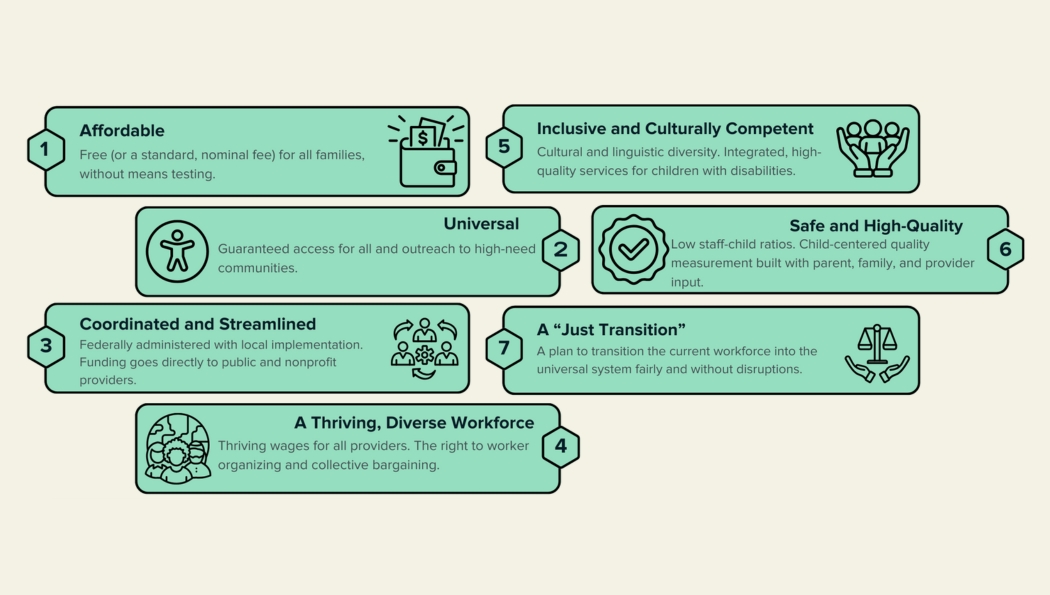
Working in partnership with the Roosevelt Institute and Community Change, we released a new report entitled, Building a Vision for Universal Public Childcare: Principles for a Childcare System that Works for Workers and Families. The report reflects on a year-long series of conversations with parents, providers, and organizers to inform a shared vision for childcare. In this vision, parents have access to affordable, universal care no matter their income or zip code. Every child has a safe, nurturing place to learn and grow during their formative years. And providers—who have held the system together on poverty wages for far too long—are finally paid fairly, supported in their essential work, and guaranteed the right to organize for better conditions.
Real-world examples show how transformative public childcare can be. In New Mexico, making childcare free for most families lifted more than 120,000 people out of poverty. In Washington, DC, universal preschool has helped thousands of parents, especially mothers, stay in the workforce. And in Canada, where provinces have built $10-a-day childcare programs, families are saving thousands of dollars a year while providers receive stable pay.
Childcare can be a public good that strengthens our families, our communities, and our economy as a whole. Read how we can get there in our new report.
What Else We’ve Been Up To
Childcare is just one piece of our fight for economic security. Across the country, from Illinois to Los Angeles, we’re putting our ear to the ground on how to build economic power for all Americans. Here’s some of what we’ve been up to this month.
“Everything’s Getting More Expensive”: What Illinois Families Told Us on the Road to Affordability Tour
We hit the road! This month, ESIL staff kicked off the Road to Affordability Tour at the Illinois State Fair, going beyond statistics and policy papers to hear directly from fairgoers about how they’re grappling with ever-rising costs. We heard from Illinoisians of all walks of life—young parents, students, veterans, small business owners, and retirees—many of whom are facing seemingly impossible trade-offs, like having to choose between rent, utilities, or groceries to balance the staggering cost of living. A few fair attendees even shared that they’ve shifted to more vegetarian meals because the price of meat in Illinois has climbed more than 11% since 2024.
We heard similar stories in Venice, Illinois, a community that has long grappled with deep economic and racial disparities. Community members voiced frustration with the high cost of living they face, but also urgency to move toward action: “We all know the problems. What I want to talk about are the solutions.”
What the ESIL team heard from fellow Illinoisans underscores why this tour matters: the affordability crisis looks different in every community, but the impact is the same—families are stretched to the breaking point. Over the next few weeks, we’ll be speaking with people throughout the state, gathering stories to shape a bold Affordability Agenda. Stay tuned for more updates from the road!
Los Angeles Doubles Down on Guaranteed Income
Big news from the City of Los Angeles!
The City Council just approved $2 million for a new guaranteed income pilot. The STAY SAFE (Supporting Transitional-Aged Youth and Survivors in Achieving Financial Empowerment) pilot will provide $1,000 a month for two years to transitional-age foster youth and survivors of domestic violence. It will also provide job training through the Hospitality Training Academy.
This pilot builds on the success of BIG:LEAP, the city’s earlier program and the largest publicly funded guaranteed income pilot in the nation when it launched. Results from BIG:LEAP showed that cash helped families cover emergency expenses, decrease food insecurity, and even reduce instances of intimate partner violence. Championed by Councilmembers Curren Price and Hugo Soto-Martinez, STAY SAFE represents the next step in Los Angeles’ guaranteed income efforts, ensuring those most impacted by instability have access to real support.
Direct cash support works—and Los Angeles is doubling down on a proven solution that puts people first and helps create the stability we all need to thrive.
ICYMI: Our Picks
From scrutiny of algorithm-driven rent hikes to fresh thinking on public groceries and debates over cash’s impact, here are a few stories that caught our attention these past few weeks.
- My response to recent reporting questioning the impact of cash
Recent headlines about the Baby’s First Years study have raised questions about whether direct cash support makes a difference to the families who receive it. In my response, I explain why design matters and what decades of research actually show: “The question we should all consider coming out of this study isn’t IF we should give families cash, but HOW we can do so most effectively.” (Graphic credit to Mayors for a Guaranteed Income. - Public Grocery Stores Already Exist and Work Well. We Need More
Op-ed in Civil Eats explores how public grocery stores could help tackle soaring food costs and corporate price gouging. The model? “There are clear models for operating a public grocery store: Combine the military commissary’s cost-plus pricing (and free delivery) with Costco’s warehouse efficiency and Aldi’s limited assortment strategy.” - Mezz x POP! Economy on how pricing algorithms are raising rents nationwide
Landlords across the country are using RealPage’s AI algorithms to raise rent prices. If landlords were doing this in person, it would be illegal, but because it’s algorithms—they get a free pass. The good news is that cities have started to ban RealPage, and states like California are proposing statewide legislation (AB 325) to ban it. “We cannot put profit maximization ahead of people’s right to affordable housing.” - ESP’s Mike Konczal takes on E.J. Antoni of the Heritage Foundation
ESP’s Mike Konczal joined C-SPAN to break down how President Trump’s economic policies protect the wealthy while shifting the cost to families, driving up prices on essentials like groceries. “They’re [Trump administration] raising prices on bell peppers…and they’re doing it so they don’t have to raise taxes on rich people.” - ESP’s Shafeka Hashash on Substack Live: The Real Story on Cash
ESP’s Shafeka Hashash joined Jeremy Ney on Substack Live to discuss the state of play on cash. They dig into why recent debates on cash miss the mark, and what it actually takes to design programs that deliver real stability for families. “There is a really gorgeous quote in OpenResearch’s most recent findings where someone said, ‘Instead of buying items, I really spent it [cash] on my kids having memories, because for me that is what they will take away from their childhood.’”