Update
Expanding the Playbook on Childcare
10. 15. 2026
Tackling the Affordability Crisis for Families with Kids
As a parent of two children under 5 living in New York City, I know firsthand that the story of childcare and our economy isn’t just about dollars and cents. It’s about families who work hard and want to be able to raise their kids and their families on their own terms—and not have to move away from the place they call home just to make it all work.
New York has made huge strides toward universal childcare by expanding 3-K seats and rolling out 2-K in the city, and committing to universal pre-K for every four-year-old in the state. But nationally, the childcare crisis leaves too many families without access to quality care they can afford. About four million young children, nearly one in three children of working parents, have no safe, high-quality childcare option nearby. If you are lucky enough to find a spot, the costs are astronomical, averaging $13,000 a year—more than public college in many states. A single parent is spending a third of their income on childcare alone, higher than the cost of housing and healthcare in some places.
The system is also failing some of the most important people in our children’s lives: childcare workers. They earn roughly $13 an hour, less than half of what elementary and middle school teachers make. Many go without healthcare or retirement benefits and rely on safety net programs to make the math work. The result is high turnover and burnout, creating instability for providers and parents alike.
As part of ESP’s broader agenda to tackle the affordability crisis across broken incomes and broken markets, we wanted to push the conventional thinking on childcare solutions. Building on our work to revitalize public options as a tool to guarantee a baseline of goods and services to communities, we worked with the Roosevelt Institute and Community Change on the principles for a universal public system and did a deep dive on supply-side strategies, convened advocates from across the country to learn from the NY playbook, and are running a narrative campaign to build the public support New York needs to stay at the tip of the spear for truly public, universal childcare.
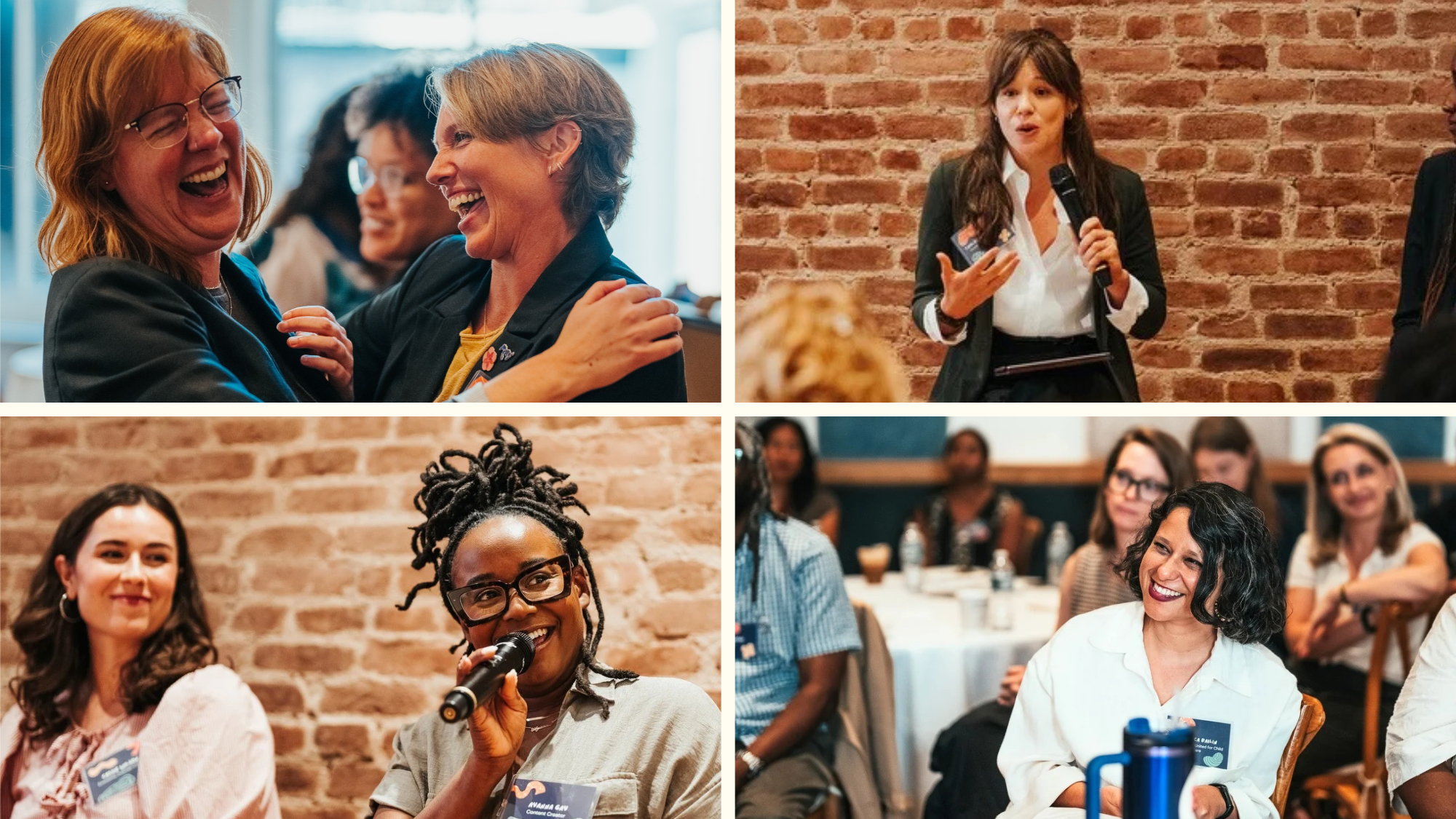
On my first day back from parental leave, I joined 100 parents, providers, organizers, and public officials from 10 states to unpack the policy, politics, narrative, and organizing behind New York’s recent childcare wins, and what advocates in other states can take home. When NYC’s beloved 3-K program faced cuts, parents led the fight to save it. We heard from New Yorkers United for Childcare and parent leaders about their campaign to make affordable childcare a statewide issue and how they successfully expanded their coalition to include labor, business, and civic groups. Members of Governor Hochul’s and Mayor Mamdani’s teams shared how that pressure helped forge a city-state partnership that led to historic investments in childcare, and narrative experts working arm in arm with creators shared how they helped make childcare the cultural fight of our generation.
Two creators from our own Economic Futures Cohort shared what that looks like in practice. Cohort alum Ayanna Gay talked about how she opened up about her own struggle finding affordable care as a mom, while current member Cassie Wilson talked about a recent video that struck a chord with her audience where she broke down the internal monologue so many Millennials and Gen Z have about the high cost of having kids. Their stories show us that a whole generation is thinking about childcare, and the momentum is there to push for solutions that go even further.
Delivering for young families means building a universal childcare system and tackling core stressors that squeeze families every month, like healthcare, groceries, and housing. In the coming months, we’ll roll out our Young Families Agenda to do both, and we’ve already started laying the groundwork with our new paper on innovative ways to expand the supply of childcare, which you can read more about below.
What Else We’re Up To
New Report Makes the Case for a Childcare Public Option
The same week we convened parents, providers, and other stakeholders in New York City, we also released A Space for All: The Case for a Childcare Public Option, co-authored by ESP Associate Director Mary Durden and fellow Maggie-Leigh O’Neill. The report explores how a public option could tackle the supply side of the childcare problem head-on by building new publicly funded and operated childcare facilities that work alongside private providers. It lays out four key strategies, including treating childcare as essential public infrastructure, holding every program to a uniform high standard, paying childcare workers wages and benefits on par with K-12 teachers, and piloting mobile childcare for families in rural areas or working seasonal jobs.
Together, these strategies can make childcare accessible and affordable for every family. Read the report here.
A Major Win Against Corporate Power in California
California just took a major step toward tackling corporate power and the affordability crisis.
Gov. Newsom signed a new law updating California’s antitrust laws for the first time in more than a century, following a multi-year campaign led in part by our affiliate, Economic Security California Action, alongside a broad coalition of advocates, organized labor, and small businesses.
California’s antitrust framework had remained largely unchanged since 1907, even as corporate power and the economy transformed around it. The new law gives state enforcers stronger tools to take on monopoly power and closes loopholes that have allowed dominant corporations to block competitors, squeeze small businesses, suppress wages, and consolidate their power.
Amid families struggling to afford groceries, housing, healthcare, and other everyday essentials, taking on concentrated corporate power is a critical part of making life more affordable. More competition means more choice for families, a fairer shot for small businesses and workers, and less power for corporations to set the terms of our economy.
This is a huge win for Californians and for everyone fighting for an economy that works for people, not just the most powerful corporations. Learn more about this historic win.
Welcome to Our New Research Fellows
We’re excited to welcome three new research fellows who bring deep expertise spanning healthcare policy and the political economy of work. Working with our Ideas Team, they’ll develop ideas and strategies that tackle the ways the affordability crisis is crushing families nationwide. Please welcome:
- Jacob Hacker is the Stanley B. Resor Professor of Political Science at Yale University, where he studies U.S. health policy, economic inequality, and the politics of risk. He’s the author of several influential books on the American economy, including The Great Risk Shift and, with Paul Pierson, Winner-Take-All Politics and American Amnesia, and he’s known for developing the public option in healthcare. At ESP, Jacob will research and identify the core pillars of a healthcare public option that can expand coverage and reduce costs for consumers.
- Gaby Aboulafia is a doctoral student studying health policy and politics at Harvard University. Her research looks at how the design and implementation of public insurance programs shape people’s experiences with government and their political attitudes and behavior. She previously researched health insurance reform and affordability at the Commonwealth Fund and worked at the U.S. Department of Health and Human Services. At ESP, Gaby will work alongside Jacob on our healthcare research, including what it takes to build a public option that works for consumers.
- Devesh Kodnani is an economist and policy advisor focused on reducing income inequality and making sure workers share in the gains from new technologies like AI. He’s completing his PhD at MIT and brings experience from the U.S. Joint Economic Committee, the Center for American Progress, and Goldman Sachs Economics Research. At ESP, Devesh will research the intersection of social insurance and labor policy, with a focus on AI’s potential impact on labor.
ICYMI: Our Picks
From the Paramount-Warner Bros. merger to what states can teach us about universal childcare, here’s what caught our attention this month:
- Five Ways the Paramount-Warner Bros. Merger Will Cost You
What happens when two of Hollywood’s five major studios combine? A new POP! Economy explainer breaks down five ways the Paramount-Warner Bros. merger will affect everyday people, from higher streaming, sports, and movie prices to billionaires controlling our news. “This is one of the largest media mergers in U.S. history, combining two of Hollywood’s 5 major studios into one company.” - What AI Should Learn From the Banks
In a new Financial Times op-ed, ESP co-founder Chris Hughes argues that AI companies should be regulated the way banks are, with independent public supervisors embedded inside frontier AI labs who oversee safety from the start and run regular stress tests. “Policymakers failed to regulate social media because they were overwhelmed by the range of problems, ranging from teen mental health to privacy and misinformation. The challenge of AI can be similarly intimidating but Congress does not need one massive bill to deal with AI. Instead, it should start with the most pressing concern today – model safety – and go from there.” - Lindsay Owens’ New Book Gouged Exposes How Corporations Are Coming for Your Wallet, and How to Fight Back
In her new book, Gouged: The End of a Fair Price, and What That Means for Your Wallet, Groundwork Collaborative Executive Director Lindsay Owens pulls back the curtain on the tricks, traps, and high-tech tools corporations use to squeeze more money from consumers. From surveillance pricing and algorithmic price fixing to hidden fees, Owens shows how these tactics are reaching nearly every part of our household budgets and offers a guide for recognizing them and fighting back. “Everywhere you turn, Americans are getting ripped off.” - Roosevelt Institute Looks to States for Lessons on Universal Childcare
In a new brief, the Roosevelt Institute examines how Connecticut, New Mexico, and Vermont are making progress toward universal public childcare, and what a national system can learn from them. Across all three states, expanding affordability has gone hand in hand with investing in the childcare workforce. But state action alone has limits, making federal investment essential to building a sustainable system nationwide. “Parents can’t pay more, and providers can’t afford to make a dollar less.” - Creator Michael Mezzatesta Uses ESP’s Affordability Dashboard to Show How Much More Everyday Life Costs
Spotlighting ESP’s new Affordability Dashboard, Michael shows how the cost of everyday essentials, from groceries and rent to beef and coffee, has climbed since 2020 while median income has barely budged. The video puts numbers behind the affordability squeeze and points viewers to the dashboard to explore how costs have gone up. “If you feel like we have been living in some sort of economic twilight since 2020, you’re not wrong.” - What Will It Take to Build Universal 2-K in NYC?
As NYC rolls out free childcare for two-year-olds, a new ESP-supported analysis from Citizens’ Committee for Children of New York maps where childcare gaps are biggest across the city’s neighborhoods and what it will take to close them.