In the Media
MICHIGAN ADVANCE: Michigan League for Public Policy Forum examines how inequality breeds gaps in democracy
04. 30. 2026
Natalie Foster, co-founder of the Economic Security Project, delivers keynote at Michigan League for Public Policy’s 2026 public policy forum
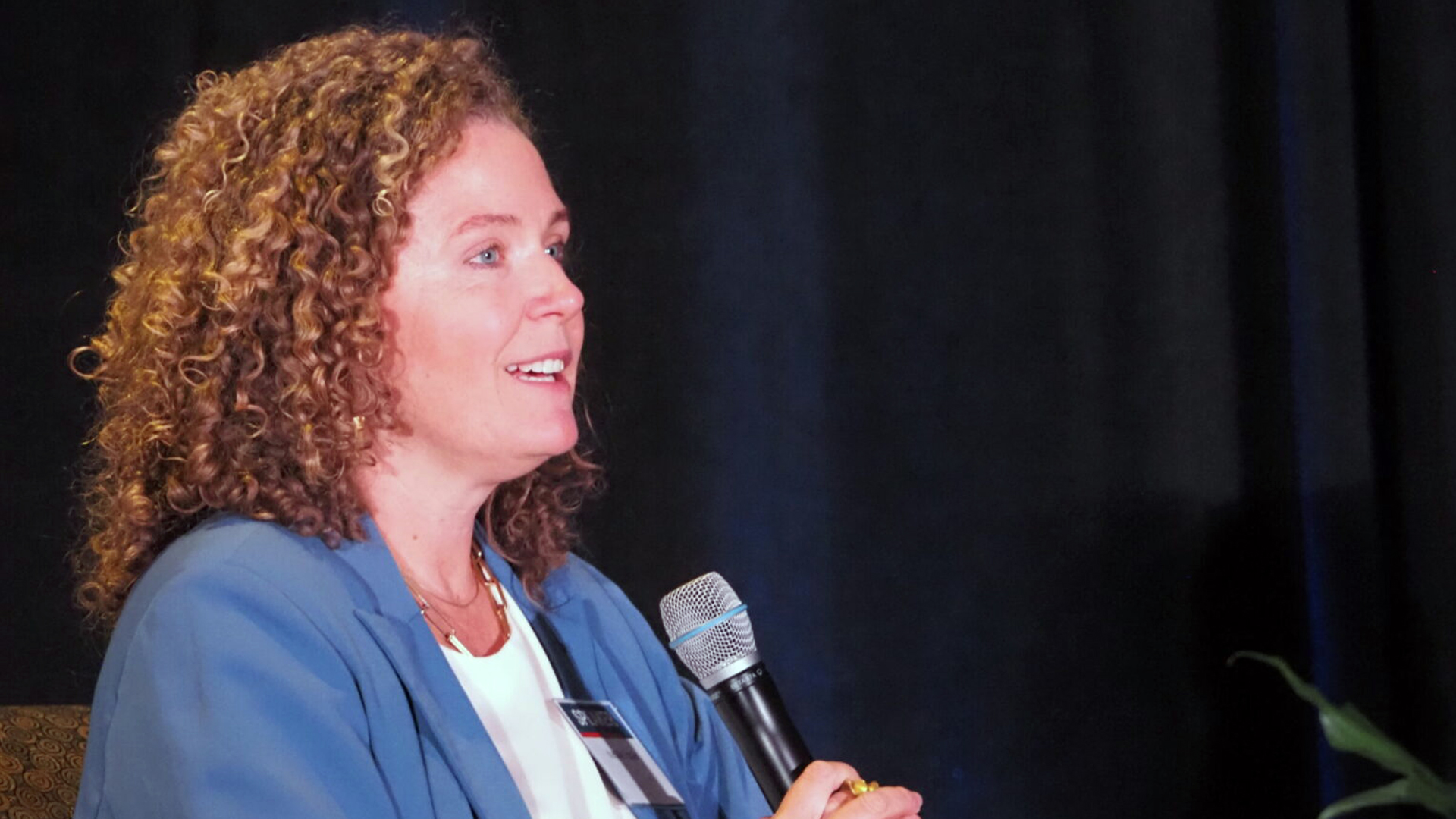
As the United States prepares to mark 250 years since the signing of the Declaration of Independence, the Michigan League for Public Policy hosted its annual forum, focusing its 2026 event on fulfilling the promise of American democracy.
Throughout the forum, speakers and panelists grappled with the United States’ long history of systemic exclusion, and how individuals who were barred from exercising the same power as the men who founded the U.S. can reshape that system for the good of all.
In the keynote speech, Natalie Foster, co-founder of the Economic Security Project, called upon U.S. Poet Laureate Ada Limón’s “A New National Anthem.”
“She talks about how it is always, always, about wars and bombs,” Foster said. “And then she asks about the stanzas that we never sing: The third stanza. The one I had to Google to ensure that’s really what it was. The one that mentions, quote, ‘no refuge can save the hireling and the slave.’”
Limón goes on to posit that every song in our nation has its own unsung third stanza, “something brutal snaking underneath us as we blindly sing the high notes.”
Foster explained that rather than calling for Americans to burn down the old anthem, Limón is calling for a new national anthem that tells the whole truth of the nation’s history, one that all can sing.
Over the last 45 years, the U.S. has told a very specific story about the economy, Foster said.
“You could call it trickle-down economics, or Reaganomics or neoliberalism,” Foster said. “It has three core tenets: total faith in the market, zero faith in government and each of us left grasping for our bootstraps.”
Economic security is essential to democracy, keynote speaker argues
Since 1980, economic growth has slowed from 3.9% annually to 2.6%, Foster explained, with the richest 1% doubling their total share of income while Black and Latino families saw their median incomes drop.
Foster noted that polling from GenForward found that 53% of young people were more concerned with their family’s economic wellbeing than their own democratic rights.
“That is a wake-up call, and I would argue, is the single greatest threat to our democracy,” Foster said. “It tells me that for a huge swath of this country, democracy feels like a luxury that they can’t afford, that they’re too busy trying to survive to pay the bills, to put food on the table. And if that’s true, then every conversation we have about democracy has to also be a conversation about economic security.”
To address these concerns, Foster advocated for a reconstructionist approach centered on three principles: building new institutions, containing reactionary and autocratic power and democratizing governing power to protect against backsliding.
“That’s what the Federal Trade Commission was, the National Labor Relations Board, Social Security did it,” Foster said. “They weren’t just programs that were created, they were power shifts.”
Over the past few decades, Foster said she and her team have been working to build a “guarantee economy.”
“The idea is this, that our government, the government of the richest nation on earth in the richest moment in history, should take responsibility for ensuring that every American’s basic needs are met,” Foster said, calling out housing, healthcare, college, dignified work and care for children, elders and disabled people as among those needs.
While some might call that radical, Foster said there are plenty of guarantees baked into the Constitution — the guarantee of stable currency, property rights and liability protections for investors.
“We have built an elaborate, sophisticated architecture of guarantees for businesses, for markets and for capital,” Foster said. “The question is, why have we not built guarantees for people, right? For our greatest asset here in Michigan and across the nation.”
The answer is not economic, Foster said, but political.
“That’s why the guarantee framework is not just an economic vision, it’s a racial justice vision, and it’s a democratic vision and it’s all three inseparably,” Foster said. “Because you know that housing insecurities, healthcare access, the quality of your kids’ schools, the cleanliness of your water, these are not separate issues. They are one issue, and they are an issue of whether democracy is working for us.”
Foster was optimistic on the U.S.’s ability to take action to meet the needs of its residents, pointing to steps the United States took during the COVID-19 pandemic to provide guarantees.
“We did things like lease empty motels so veterans experiencing homelessness could be moved in, could be given a key to a room of their own,” Foster said. “Student debt was paused for millions and then eventually abolished for many of those students. We developed a vaccine and we mobilized the National Guard to give it away for free.”
Panelists frame democracy as a struggle over power and access
Following Foster’s speech, Gongwer News Service President Zach Gorchow led a discussion with a group of panelists working to build democratic power for disabled individuals and communities of color.
As a means of exercising power in the nation, American democracy has typically been white, able-bodied and affluent, said Micheal Davis Jr., executive director of Promote the Vote Michigan, which successfully advocated for two ballot initiatives to expand voting rights.
For those on the outside, that structure has typically been oppressive, violent and abusive, Davis said. However, democracy is also seen as a necessary tool for communities seeking to level the playing field, he said.
“It’s not really a policy fight, it’s a fight for power,” Davis said, noting that the folks who need that power the most have to continue to fight to protect the gains they’ve made to ensure their access to the ballot box.
Dessa Cosma, founding director of Detroit Disability Power, emphasized that this dynamic is nothing new, but that those on the receiving end of power are not powerless.
“We have an opportunity to collectively work to rebuild this thing as something that actually works for people,” Cosma said, pointing to organization and taking collective steps to leverage political influence as the pathways to social change.
For Meredith Migizi, founder and executive director of Miigwech Inc. and a tribal citizen of the Little Traverse Bay Bands of Odawa Indians, Foster’s push for economic support is nothing new.
“It’s a really weird space to be in and hear about guaranteed income, hear about guaranteed housing, hear about guaranteed childcare, when that literally is what this land remembers, and what my ancestors specifically, because I am a descendant of an 1836 treaty signer, what we wanted for your community while you’re on our lands,” Migizi said.