Universal Public Childcare
A Space for All: The Case for a Childcare Public Option
09. 16. 2026

Executive Summary
Childcare is a critical public need, but the market meant to provide it is broken. The United States is the only economically advanced nation that doesn’t recognize childcare as a public good. There are only 10.8 million slots in licensed or registered programs for the 14.8 million children ages five and under who need care, leaving more than 4 million children without access to nearby care. This means nearly one in three young children of working parents lack access to a licensed childcare slot. A center-based childcare slot costs $13,000 annually on average, outpacing the price of public college in many states. In other words, on average, to afford childcare, a single-parent household must spend 33 percent of their annual median income. What’s worse, childcare costs are rising 1.5 times faster than overall inflation, pushing access to affordable care even further out of reach for families. This lack of access costs families, businesses, and taxpayers an estimated $122 billion annually as a result.
Broken markets and broken incomes are the dual drivers of the broader affordability crisis facing Americans today, as Economic Security Project’s (ESP) Affordability Framework explains. Examining the childcare crisis through this lens is the context for the policy recommendations we posit in this paper. While Head Start/Early Head Start and Universal Pre-K are popular, effective programs, neither can independently address the entirety of the early childhood education supply shortage. To address both broken markets and broken incomes, the childcare sector needs a dedicated public option: new, government-funded, operated, and regulated childcare facilities that exist alongside existing programs and private providers within a broader mixed-delivery system.
This paper lays out what a public option for childcare must entail to effectively meet the needs of parents and families. This includes, but is not limited to, building more facilities in communities the market has failed to serve, higher quality care for every family, and a better-paid workforce that can sustain an expanded childcare system over time. It also makes the case for mobile childcare models to reach families in childcare deserts that even a robust fixed facility network wouldn’t reach.
Current childcare policy has largely generated demand-side solutions – that is, helping families afford childcare that already exists – via subsidies, vouchers, tax credits, and subsidized tuition, but fails to invest in the supply families actually need to meet that demand. A public‑infrastructure strategy addresses this imbalance by funding, building, and owning childcare facilities directly, rather than relying solely on the private market to expand capacity. There are four essential strategies to effectively build a public option:
- Expand supply. Childcare spaces must be recognized as essential public infrastructure. This requires targeted investment to rehabilitate existing facilities and develop new ones, supported by federal intervention, uniform licensing and safety standards, unified data systems to identify need, and public-private financing partnerships including Community Development Financial Institutions. The Department of Defense’s mixed-delivery childcare model and New York state’s recent $100 million capital construction investment, aimed at adding up to 10,000 new childcare slots, both demonstrate that this kind of infrastructure investment is already being tested at scale and can be replicated and expanded.
- Establish a standard of high-quality care. Only 10 percent of childcare programs nationwide are considered high-quality. Existing state Quality Rating and Improvement Systems have produced inconsistent results and, according to some early childcare and education scholars, are racially biased evaluation tools. We recommend anchoring public option quality standards in the Head Start Program Performance Standards, paired with community-driven governance that lets families and providers shape systems reflecting local needs.
- Invest in the workforce. The median rate of pay for a childcare worker is $13 an hour, and 43 percent of the workforce lives in persistent economic precarity, relying on social safety net programs to make ends meet. A public option would ensure this workforce has access to the pay, benefits, and institutional supports comparable to those available to federal employees and K-12 educators, building on state efforts already underway to establish pay parity and dedicated compensation funds.
- Pilot mobile systems. Fixed facilities, however well-funded, cannot reach every family. Rural communities, seasonal and migratory workers, and unlicensed family, friend, and neighbor caregivers all face barriers that a permanent building cannot solve. There are currently few mobile childcare models in the U.S., but international examples, like Colombia’s publicly-funded Care Buses, and early domestic models like Illuminate Childcare Colorado, offer a starting point for piloting this approach as a complement to, not a replacement for, traditional childcare infrastructure.
Federal adoption of a universal public childcare system may be closer than it once seemed. To catalyze implementation, affordability must move with supply. We seek to grant all families equitable access to quality care through a public option, existing alongside private programs, as a part of a broader, federally funded mixed-delivery system that treats childcare spaces as essential public infrastructure, reaching children across communities, and adequately compensating the workforce with thriving wages and support. A forthcoming companion piece will address direct cash strategies for families and caregivers as a complementary bridge to fix broken wages in the childcare system.
Introduction
Childcare is a critical public need. High-quality childcare and early learning environments produce positive externalities for society writ large: in California, for example, every $1 spent on early childcare and education (ECE) generates an estimated $1.88 in economic activity (Powell et al. 2019). While children and families are the immediate beneficiaries, a plethora of longitudinal evidence shows communities, businesses, and economies also flourish when high-quality childcare is affordable and accessible (CCAoA 2025). Paradoxically, the U.S. is the only economically advanced nation in the world that does not recognize childcare as a public good. As a result, the sector operates in a fragmented market defined by stifling structural constraints making it particularly vulnerable to macroeconomic fluctuations and microeconomic dynamics.
Applying the most basic principles of economics, profitability is impractical when revenue primarily relies on families who cannot afford the true operating costs of care. Caregiving is costly because it is inherently labor intensive making salaries the largest expense for businesses. The physical spaces where licensed childcare is provided are rigorously and rightfully regulated by health and safety standards, based on the processes of early childhood brain development and their long-term implications, prescribing specific staff-to-child ratios, by age group (NAEYC 2020). These ratios make childcare tuition more expensive for infants and toddlers. The childcare sector also suffers from liquidity constraints (CCAoA 2025). Parents cannot borrow against projected future income to cover current costs of care and the pool of capital available to the businesses supporting the sector is frustratingly sparse. Simply put, our country’s childcare business model is broken (Figure A).
FIGURE A: Childcare is a Broken System
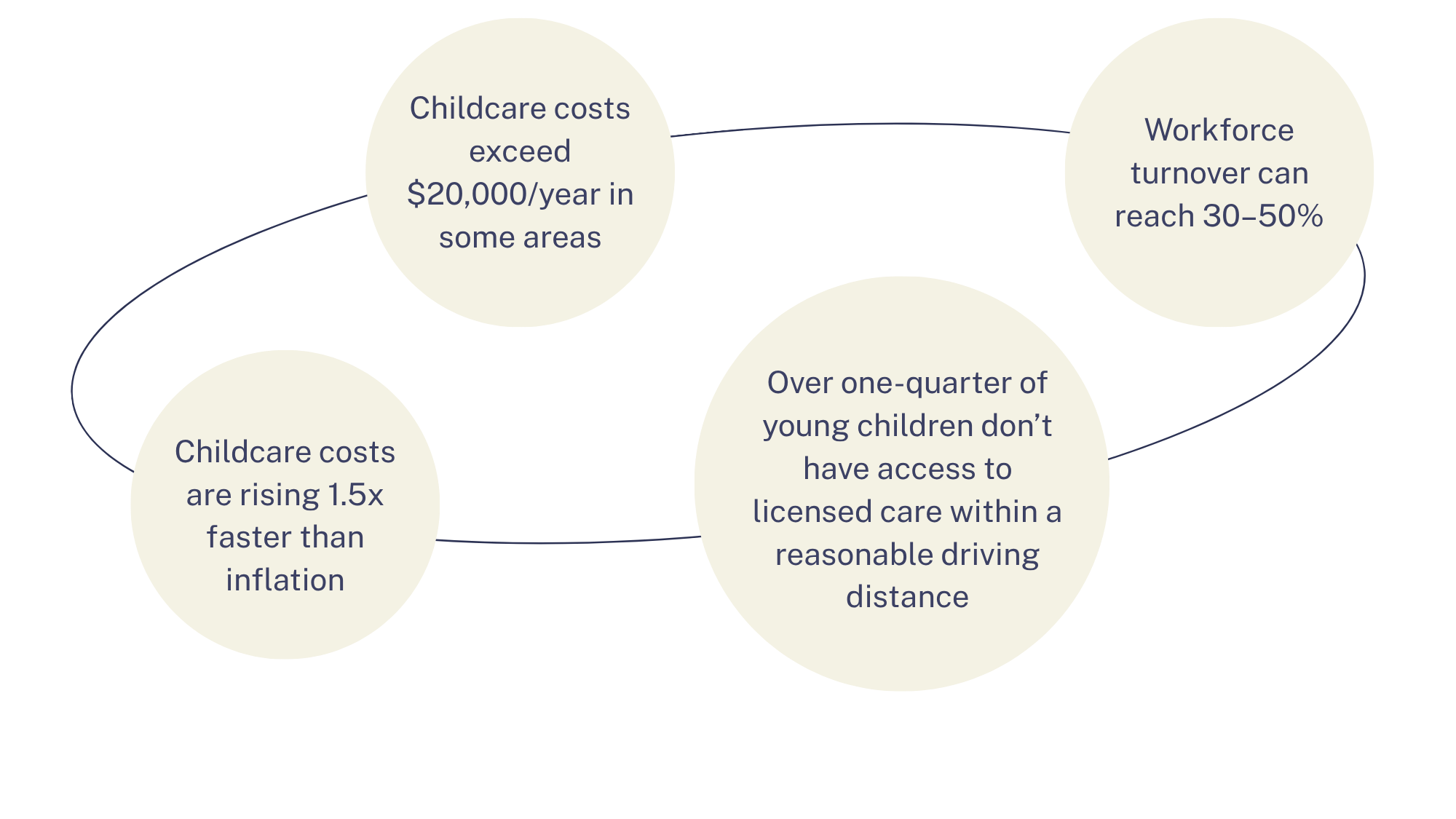
There are approximately 14.8 million children under the age of five in the U.S. who potentially need childcare (Smith and Bagley 2026), yet only 10.8 million slots in licensed or registered programs exist (Smith and Bagley 2026). This leaves more than 4 million children without access to a licensed care slot within a reasonable distance, creating a myriad of difficult decisions families must grapple with (Smith and Bagley 2026). For some families, the back-of-the-envelope calculation equates to parents and guardians opting out of the workforce altogether. The tough decisions families are forced to make can have far-reaching repercussions beyond lost earnings, leading to long-term affordability issues like less retirement savings or increased reliance on social safety nets. The families who cannot afford to stop working must rely on a patchwork of formal and informal childcare, based on cost and convenience, rather than quality. The bottom line is American families, businesses, and taxpayers lose $122 billion annually due to childcare challenges (ReadyNation 2023).
Our VisionOur Vision for Universal Childcare
For years, ESP has advocated for bold ideas to ensure families have the resources they need to thrive. To build an economy that works for everyone, families must have access to basic necessities like food, utilities, healthcare, and childcare. To that end, we are working to build a shared understanding of universal childcare, centered around the tenets captured in our work published in partnership with the Roosevelt Institute and Community Change: Building a Vision for Universal Public Childcare: Principles for a Childcare System That Works for Workers and Families.
A successful universal public childcare model must be:
- Affordable: This proposal will only be successful if it is accompanied by a significant federal investment to make childcare affordable (if not free) and expand access by growing supply.
- Universal: Universally accessible, with childcare as a legal right to all children with an affirmative obligation to ensure sufficient spots exist.
- Coordinated and Streamlined: Upheld by coordinated, non-fragmented governance structures; Federally administered through state and/or regional infrastructure to support implementation and expansion.
- A Thriving, Diverse Workforce: Thriving wages and benefits for a valued and well-resourced workforce, as well as the right to worker organizing and collective bargaining.
- Inclusive and Culturally Competent: Provide culturally and linguistically competent care, options of expanded hours outside of the school day, and universally accessible services for early intervention and services for children with disabilities.
- Safe and High-Quality: Child-centered safety and quality with strong and consistent guidelines built with parent, family, and worker input.
- A “Just Transition”: A universal public system must be built through a process that includes a just transition for the current workforce.
“We seek to build a public infrastructure of care that is sustainable, affordable, high-quality, and universally accessible first and foremost.
The Roosevelt Institute, 2025
The system should meet the needs of families, including but not limited to: the needs of children with disabilities; the financial needs of families; the need for full-day, full-year care; the need for high-quality and age-appropriate youth development, care, and education; and the need for young children to have attentive, consistent adult relationships.”
To fix our nation’s broken childcare model, thought-leaders and policymakers must think expansively with a broader toolbox (Mickelson 2026). In addition to making care affordable for more families, improving workforce wages, and reducing barriers to licensure, we must also solve for supply. We will champion public option solutions defined as new government-funded, operated, and regulated childcare facilities to build toward a truly universal childcare system. A childcare public option is essential to achieving universal public childcare. Our country has a long history of deploying public options: from the postal service to libraries, to public K-12 education, they’ve all provided essential services and ensured healthy competition to keep the private sector accountable to the public it serves. Current childcare policy has largely generated demand-side solutions – that is, helping families afford childcare that already exists – via subsidies, vouchers, tax credits, and subsidized tuition, but fails to invest in the supply families actually need to meet that demand. A public‑infrastructure strategy addresses this imbalance by funding, building, and owning childcare facilities directly, rather than relying solely on the private market to expand capacity. By recognizing the physical spaces where providers and programs operate as essential public infrastructure and publicly funding childcare facilities, we can address a key gap: the lack of childcare supply. We will drive the conversation toward the systemic benefits of a public option to address supply shortages and explore how strategic infrastructure investments, paired with pro‑caregiving workforce policies, will ultimately improve access and quality across the sector.
Childcare Policy
Building a universal public childcare system in the U.S. is feasible. It is a practical, evidence‑based policy choice well within our collective capacity. We have a deep history of doing so. During World War II working families had access to federally-funded childcare facilities. The Lanham Act of 1940 was a defense-community facilities act that appropriated funds to support the nation’s primary wartime workforce: mothers (PN3 Policy 2025). Through amendments, select communities received federal funding to convert existing and create new childcare infrastructure and operate quality programs run by professional staff, offering nutritious meals and extended hours (Ferrie et al. 2024). The program was eliminated in 1946, marked by the end of the war and the expectation that the wartime workforce would reassume traditional gender roles as stay-at-home caregivers.
Three decades later, Congress passed the Comprehensive Child Development Act of 1971 (Roth 1976). The bipartisan bill vetoed by President Nixon proposed a national framework for the universal provision of childcare and a dedicated stream of federal-funding to set quality standards, subsidize care based on a sliding fee scale, workforce training, and facilities. As a result, universal childcare advocates shopped smaller scaled concepts to state officials and states effectively absorbed the responsibility. Although the Comprehensive Child Development Act of 1971 failed, significant federal legislation correlated with the Civil Rights and Feminist movements of the 1960s and 1970s succeeded (Roth 1976). These laws expanded legal rights for women in the workplace and increased their access to higher education institutions. For the next fifty years women’s educational attainment and labor force participation grew exponentially.
In March 2020, to stop the spread of the coronavirus, the federal government mandated a nationwide lockdown. Some of the businesses and institutions providing childcare closed temporarily and others closed permanently. The primary source of care many families relied on for decades became virtually inaccessible overnight. As a result, millions left the workforce to care for their children. The pandemic exacerbated the magnitude of our childcare crisis from which the country has yet to fully recover (CCAoA 2022).
The current presidential administration’s concerted efforts to freeze, delay, and eliminate federal funding for childcare programs compounds the financial strain already crippling providers and families (Small et al. 2026). In December 2025, a YouTuber’s unsubstantiated accusations of fraud in Minnesota gained national attention, prompting an executive order to establish the “Task Force to Eliminate Fraud” (MN, DCYF 2026 and WH 2026). On top of that, the House of Representatives recently passed a package of bills further aggravating the issue citing defunct data to defend egregious funding cuts and constraints to childcare programs (FFYF 2026 and Home Grown 2026). Factually, federal childcare fund recipients are subject to vigorous oversight and only a fraction of improper payments cases are classified as fraudulent (FFYF 2026).
In July 2026, the Restoring Flexibility in the Child Care and Development Fund (CCDF) final rule went into effect (FR 2026). The rule, proposed by the Department of Health and Human Services (HHS), rescinds “the four most onerous” regulatory changes added by the Biden Administration in 2024: the co-payment cap of no more than 7 percent of household income for families receiving CCDF assistance; paying childcare providers prospectively rather than retrospectively; paying providers based on child enrollment rather than attendance; and using grants and contracts to build supply for underserved populations (FR 2024). Returning to retroactive, attendance-based payments will create immediate cash-flow instability for providers, creating solvency threats that private markets cannot hedge or absorb. In addition, the Restoring Flexibility to Support Head Start Program Access went into effect in August 2026 (FR 2026), rolling back Biden Administration requirements for wages, “programs to ensure all Head Start staff receive pay that is at least sufficient to cover basic costs of living in their geographic area” and benefits to “support the wellness of the Head Start workforce” (FR 2024).
In spite of these setbacks, partisan polarization on childcare may be starting to shift. There is bipartisan support for public investment: 75 percent of voters believe childcare funding should be increased or kept at current levels, including 75 percent of Republicans, 85 percent of Independents, and 97 percent of Democrats (FFYF 2026). According to a report recently released by New America “a majority of Americans think the government should help all families pay for care, but don’t understand what universal childcare means (Schulte and Haspel 2026). Moreover, a new proposal from the Project 2029 think tank envisions an America that embraces childcare access, affordability, and parental choice (Cohn 2026).
Affordability Framework
Today in America, the average annual cost of one center‑based childcare slot is $13,000, more than the price of public college in many states (Gutierrez and Kashen 2025 and CCAoA 2025). In other words, to afford center‑based childcare, a single-parent household must spend 33 percent of their annual median income on average (CCAoA 2025). What’s worse, childcare costs are rising 1.5 times faster than overall inflation, pushing access to affordable care even further out of reach for families (Bowley 2025). ESP’s Affordability Framework, which identifies broken incomes and broken markets as the dual drivers of the affordability and childcare crises, is the basis for the policy recommendations outlined in this paper. (ESP 2025).
The U.S. childcare system is broken with childcare remaining perpetually unaffordable, due in large part to three systemic failures: gatekeepers, fragmented markets, and manipulated signals. ESP defines gatekeepers as corporate power and weak governance that constrain supply and raise prices. Fragmented markets are defined by market constraints that prevent providers from scaling goods to the level needed to meet public demand. Manipulated signals occur when prices fail to reflect true costs and benefits because sellers obscure information, forcing others to pay more. Early childcare programs operate by blending and braiding a small pool of federal, state, and local public and private funding streams. Longstanding structural constraints disincentivize the industry’s patchwork of providers and enable consolidation conditions for gatekeepers, like private equity firms (Stienon and Boteach 2024).
Families cannot afford the true-cost-of-care, forcing childcare providers to operate in fragmented markets under the guise of manipulated signals. Although the workforce is paid extremely low wages, salaries are childcare programs’ largest expense and most providers struggle to afford the facility maintenance and improvements required to meet minimum quality standards (Stienon and Boteach 2024). Typically, this type of market failure is corrected by government and/or private market interventions but profit-maximizing behavior does not incentivize universal access to high-quality childcare and federal childcare funding is only available to a sliver of low-income families, reaching even fewer in practice. What’s more, public funds do not fill the cost gap incurred by caregivers (e.g., providers and families).
Even when markets work, broken incomes keep childcare unaffordable for three reasons: life cycle mismatches, inequality, and macroeconomic trends. Life cycle mismatches occur when big costs arrive, when earnings are low, in early career or when we are incapable of working. Childcare expenses relative to earnings often result in life cycle mismatches for most families with incomes that reflect their early careers. Childcare is a major, non-deferrable expense with no private market mechanisms to offset the costs. Households reliably face overlapping financial demands during this period making it extraordinarily expensive for growing families who require safe, functional living environments. Adding children can drive households into costly rental agreements or the mortgage market. Because access to high‑quality K-12 public schools is geographically anchored, households often relocate during early childhood to secure future educational opportunities. As a matter of course, relocation often destabilizes childcare arrangements and disrupts continuity of care. Inequality, in the form of insufficient incomes paired with the high cost of being poor, makes affordability worse. The federal subsidy programs available to low‑income families are notoriously difficult to navigate, with fragmented eligibility rules and overburdened state agencies struggling to administer them. The gender pay gap, traditional gender roles related to caregiving, and the motherhood penalty are just a few factors contributing to fundamental income inequalities. Macroeconomic trends like recessions have long-lasting consequences on people’s lives, and an inflation shock eats up wage gains. Today’s macroeconomic trends are driven by a series of unprecedented global events and an unpredictable administration exacerbating already turbulent conditions.
Why a Public Option?Why a Public Option?
Public Option
Public option childcare refers to government funded facilities, centers, and/or spaces complementary to other childcare options within a universal, mixed-delivery system including publicly funded programs (e.g., Head Start, Universal Pre-K, private facilities receiving public funding). Our nation’s mixed-delivery system supports parental choice and family flexibility through a variety of quality early childcare and education programs, providers, and settings (e.g., Head Start, center-based childcare, home-based childcare, public schools, and community-based organizations) supported by both public and private funds.
Public option childcare is an essential component to achieving an inclusive vision for universal public childcare. Public option childcare spaces, new and existing, are funded, operated, regulated, and staffed by the government. Public option childcare creates access to high-quality childcare slots for families, increasing supply.
Public option implementation should be phased and administered with support from state and local partners to evaluate effectiveness. Initial locations for public option childcare spaces should be selected by need, as determined by the local community. Licensed childcare deserts are a helpful tool for site identification.
By focusing on creating new publicly funded facilities, we are addressing a key gap in the childcare movement. The values presented herein are long and short-term strategies for public option childcare implementation.
Public option childcare would create the infrastructure to reduce shortages and licensed childcare deserts and help close class-based educational gaps; reduce financial strain on families; and support parents’ employment, earnings, and careers. There is renewed energy to mobilize toward federal adoption of a universal public childcare system (FFYF, Cohn, Schulte and Haspel, 2026). To accelerate the pathway, we must pilot, evaluate, and scale innovative policy solutions. This paper recommends in-depth exploration to move toward our ultimate goal of delivering high-quality universal public childcare to all families.
In considering our solutions, it’s imperative to prioritize the following tenets:
- Our current childcare model is a market failure, there is not sufficient supply to meet demand; and
- any disenfranchisement of our mixed-delivery childcare system is counterintuitive. Ideas must be additive, focused on investing, empowering, and enriching existing public and private providers and programs.
Head Start and Universal Pre-K
For purposes of this discussion, public option childcare will exist as part of a broader mixed-delivery system which includes Head Start/Early Head Start and Universal Pre-K. These are wildly popular programs among parents and participants as they offer consistent quality, improved worker pay and benefits, and play critical roles in serving the care needs of families; however, a campaign solely focused on expanding Head Start/Early Head Start or Universal Pre-K may limit the experimentation and piloting needed to test a broader universal childcare approach.
“Forcing families to wait until kindergarten to access free and public education is contrary both to what is understood about child brain development and the economic realities young families face.”
Center for American Progress, 2026
Public Option Facilities, Services, and Mobile Systems
Existing solutions to increase childcare supply and infrastructure are neither panoramic nor sufficient. Ensuring all families have equitable access to high‑quality childcare requires targeted investments that rehabilitate and enrich existing spaces while also identifying and developing new spaces. In this section, we explore space-based strategies to expand and diversify supply, increase access to high-quality programs, and improve workforce conditions, compensation systems, and support.
Supply
Barriers
The main forces constraining supply across communities – affordability, availability, utilization, and regulation – are core determinants of childcare accessibility. Affordability is the extent to which families can reasonably cover the cost of childcare without compromising their financial stability. Family childcare homes are slightly less expensive than centers in spite of operating with strikingly fewer resources and far tighter margins (Home Grown). Presently, there is no consensus on what constitutes affordable childcare or on a standardized way to measure it (CCAoA 2025). As previously mentioned, the HHS final rule limiting co‑payments to 7 percent of family income, exclusively applied to families receiving federal childcare subsidies and has since been eliminated by the Trump Administration (FR 2026 and NWLC 2026). Moreover, assessing availability is more nuanced than counting providers or licensed slots. As a metric, availability accounts for how readily families can access appropriate childcare options that align with their needs, preferences, and circumstances (Figure B). In addition to affordability and availability, we must also consider utilization: geographic distances, hours of operation, provider reliability and trustworthiness, and cultural preferences (Smith and Bagley 2026).
FIGURE B: More than 80 percent of families report difficulty finding or accessing care they want for their children
Percentage of families reporting difficulty finding child care and number of affected children, 2023
| Level of difficulty finding child care | Reported degree of difficulty finding care | Number of affected children |
| No difficulty finding care | 17% | 1,564,000 |
| Difficulty finding care | 72% | 6,624,000 |
| Could not access desired program | 11% | 1,012,000 |
| Source: Center for American Progress, Hailey Gibbs and Casey Peeks. https://www.americanprogress.org/article/americas-licensed-child-care-deserts/ | ||
Regulatory frameworks define the entry conditions and operational requirements that govern how childcare providers and programs open, operate, and sustain their services. Licensing regulations vary greatly by state and the systems and agencies administering and enforcing these regulations are difficult to navigate. States have separate rules for center-based and home-based childcare and many divide home-based care into subcategories. Local laws like zoning ordinances and land use policies that go beyond or conflict with state licensing regulations further restrain accessibility. Licensed providers often cite fragmented program standards and compliance requirements across agencies as systemic shortfalls that undermine coherence, increase administrative burden, and impede growth (Porter and Bromer 2020). In addition, childcare data is fragmented across states, counties, and agencies due to inconsistent data standards and limited data-sharing between the varied agencies that administer and oversee childcare (Alibadi 2025).
Implementation
By leveraging federal intervention, administration, and funding, public option childcare can establish uniform health and safety standards, implement simplified licensing processes, consolidate governance structures, and incubate data-collection systems to assess community childcare needs and infrastructure inventories. Accredited evidence plainly shows the spaces childcare programs and providers operate in directly affect childhood development (Harvard 2016). However, state licensing regulations and codes distinctly lack the inclusion of certain provisions that are essential to provision of high-quality care. For example, access to natural light throughout the day supports a child’s cognitive health, emotional wellness, and supports their development and over the years numerous studies have been conducted all indicating that daylight fosters higher student achievement (CIF-CEDAC). Notably, the General Services Administration Child Care Center Design Guide plainly states: natural light should be the primary means of lighting the classroom space and locations without any access to natural light should not be used for new childcare centers (GSA 2003). Troublingly, the majority state licensing regulations never mention the term natural light (LISC 2022). Establishing and enforcing universal baseline health and safety infrastructure standards (e.g., clean water, lead exposure, air quality, ratios and group sizes, square footage) and licensing requirements will ease burdens on providers and improve access without compromising quality.
Consolidating governance under a single agency dedicated to childcare would streamline oversight and resource sharing. Because public option childcare is operated by the federal government, effective administration will require robust, unified data‑collection systems that can map providers, capacity, needs, and gaps to identify the most strategic geographic locations and spaces for programs. Unified data systems can map the full childcare landscapes, capturing provider capacity, family needs, and gaps such as limited infant–toddler slots, unmet demand for nonstandard‑hour care, and inadequate support for children with disabilities, immigrant families, and English‑language learners. They can also produce an inventory that pinpoints existing or eligible infrastructure and guides capital investments to convert, improve, and/or create more high-quality childcare spaces. Targeted, intentional investments in spaces can shift the conditions that shape how children grow, learn, and thrive.
Community Development Financial Institutions (CDFIs) are mission-driven financial institutions that have spent decades figuring out how to finance childcare facilities in places where private capital has not. CDFIs like Children’s Investment Fund, First Children’s Finance (FCF), Low Income Investment Fund (LIIF), IFF (formerly Illinois Facilities Fund), Reinvestment Fund, and Local Initiatives Support Corporation (LISC) already have the expertise, relationships, and financing tools to make childcare construction happen in underserved communities, expertise that should make them central partners in building out a public option. In recent years, CDFIs cite co-location as a promising childcare supply-building, community-focused strategy. Co-location projects offer childcare solutions in or near critical community spaces to promote economic development. Co-locating childcare with affordable or supportive housing in mixed-use developments prioritizes “proximity, accessibility, and feasibility” for working families and diversifies funding sources for developers (LISC 2025). CDFIs’ unmatched expertise positions them as invaluable collaborative partners in the successful establishment and implementation of our public option solution.
Activating community planning and fiscal management tools, like master plans and capital improvement plans, can expand and diversify access to childcare spaces. There is a significant opportunity to address affordable housing and childcare shortages in tandem by utilizing innovative strategies like co-location to help working parents maintain employment and support family economic mobility which in turn strengthens the economy. Thoughtful predevelopment grounded in collaboration with state and municipal leaders and early engagement with zoning and planning boards helps communities meet childcare supply needs and ensures providers have access to the resources and partnerships required to grow existing programs or develop new spaces.
Case Studies
Department of Defense
The Department of Defense (DOD) childcare program model offers valuable lessons for policy development, though it also highlights shortcomings that warrant further reform. In Fiscal Year (FY) 2025 the U.S. spent $31.26 billion on early childcare and education equating to approximately 0.3 percent of gross domestic product (GDP), far below the Organization for Economic Cooperation and Development (OECD) member nation average of slightly more than 0.8 percent of GDP (FFYF 2025, OECD 2026, and Peeks 2024). Conversely, the U.S. spends about 2.8 percent of GDP on defense, much more on defense than any other country (PGPF 2026). In FY 2025 the U.S. spent $893 billion on defense with the majority, 59 percent, allocated to Operations and Maintenance (e.g., 38 percent) and Military Personnel (e.g., 21 percent) (PGPF 2026). Notably, nearly 40 percent of service members have children, many under age five, making access to childcare critical for military families (FFYF 2025). In fact, the DOD operates the largest employer-sponsored childcare program in the country and continues expanding access by optimizing the existing mixed-delivery childcare system (Lopez 2025). To bridge the supply gap in locations where accredited care is unavailable the DOD invests in the “Military Child Care in Your Neighborhood” program (MCCYN). To ensure eligible families can access the type of care that best meets their needs, including in-home care, the DOD finances fee assistance programs like “Child Care in Your Home” (CCYH). As recently as December 2025, the National Defense Authorization Act, commissioned over $491 million for the DOD to partner with nonprofit agencies to design and build new childcare facilities exclusively for military and DOD civilian families in high-demand areas (NDAA 2025 and FFYF 2025). These significant childcare investments indicate an inherent understanding that providing military families access to high-quality childcare is a strategic necessity. While the DOD’s childcare program is far from perfect, as highlighted by a Government Accountability Office Report released in June 2026, it nonetheless provides a valuable blueprint for optimizing our existing mixed-delivery childcare system in a public option childcare model (GAO 2026).
State Funded Universal Childcare Programs
In March 2026, New Mexico became the first state to codify a universally accessible childcare system in which all families, regardless of income, are eligible to receive assistance (SB241). Expanding eligibility assistance instantly increased demand but the state’s supply cannot keep pace (Mickelson 2026). To sustain universal access New Mexico must rely on its robust, mixed-delivery system to incrementally expand and strengthen its supply. To create more caregiving spaces, the state is offering low interest loans and capital for the construction, expansion, and renovation of licensed facilities and making entry easier for family, friend, and neighbor (FFN) caregivers to become state registered home-based childcare providers. New Mexico is making great strides to increase program quality by focusing on workforce pay parity ensuring that funding expansion is paired with meaningful workforce investment and activating the long established principle that investment in ECE workforce is the best way to improve program quality (Gibbs and Peeks 2026 and ZTT 2023).
New York State is making a significant effort to deliver affordable, universal childcare statewide (S3415A). Acutely aware that its districts lack suitable spaces, the state allocated an additional $100 million in the Childcare Capital Construction Funding program in 2026, aiming to add up to 10,000 new childcare slots for New York families (DASNY 2025 and OCFS-NY). Grant awardees will receive $500,000 to $5,000,000 to develop new or expand and improve existing childcare centers or facilities and cover costs related to planning, renting, renovating, operating, and purchasing equipment (DASNY). The state expects to have universal pre‑K available to every four‑year‑old by the start of the 2028–2029 school year (NY-GOV). In New York City unionized, center-based early educators are paid a minimum of $18 an hour and Mayor Mamdani promised during his campaign to fight for pay parity between early educators and K-12 teachers (Woods and Kashen 2026).
Quality
Barriers
High-quality learning environments benefit everyone: children, families, caregivers, support staff, and the broader community. In fact, access to high‑quality childcare can function as a stabilizer for families in under‑resourced communities, with research showing it can buffer children against the effects of poverty and create more resilient developmental pathways (Meek et al. 2026). Providing and maintaining quality learning environments is critical for early childhood growth and development, but quality comes with a cost. The tuition fees families pay often don’t cover the full cost of operating a high-quality program and providers can’t simply raise fees the way other businesses do. While poor curb appeal or a defunct website may not reflect program quality, these first impressions inevitably influence parental perception and decision-making.
FIGURE C: Razor Thin Margins Even Thinner in 2025
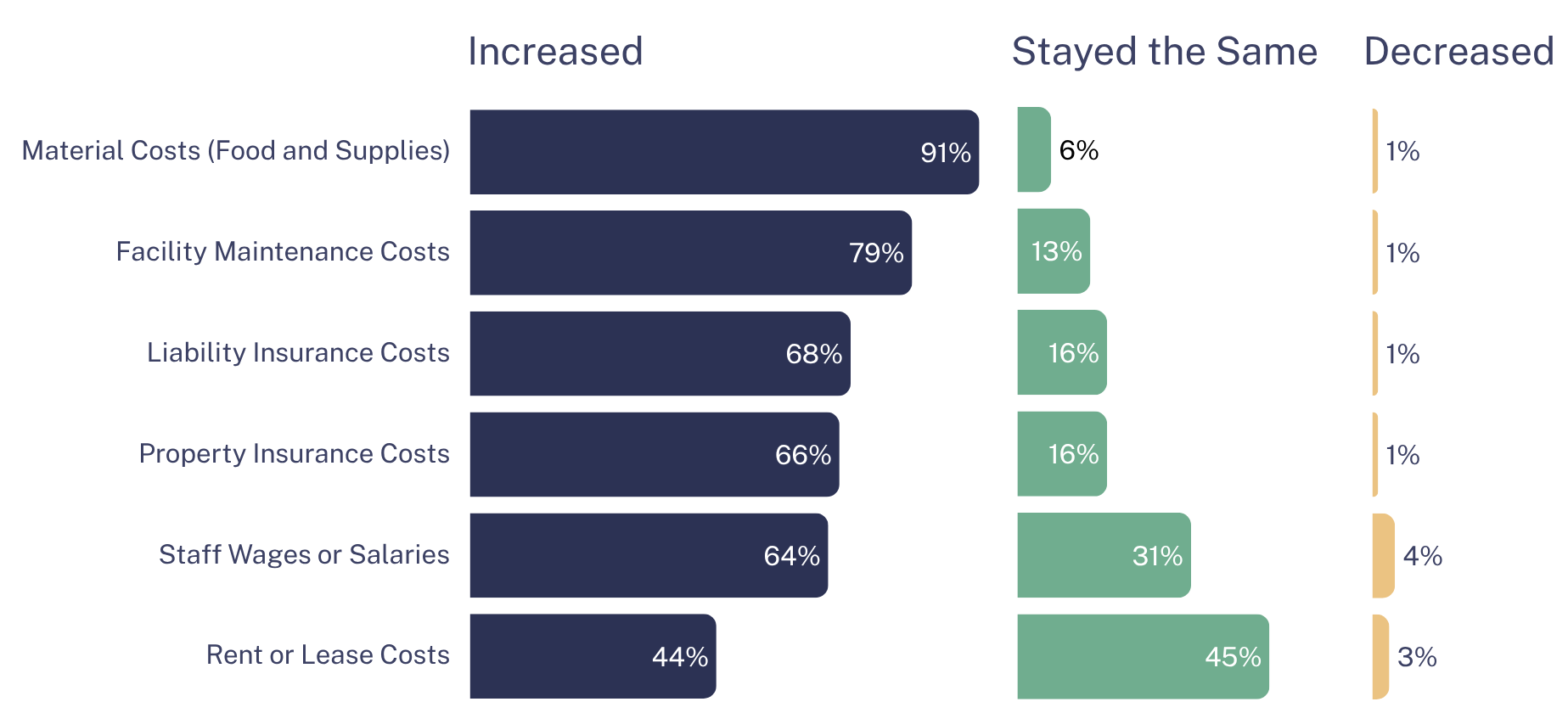
Given the industry’s tight operating margins and lack of capital for maintenance and improvements, providers across the country struggle to balance program quality standards and financial viability (Figure C). As a result, high-quality childcare spaces and by extension, experiences and outcomes, vary greatly by zip code, program type, and funding stream. With just 10 percent of childcare programs considered high‑quality nationwide, families are navigating a system that routinely fails to meet their needs (Workman and Ullrich 2017). The lack of accessible quality care forces parents into impossible tradeoffs.
What’s more, there is no single standardized definition of high-quality childcare or unified measurement tool to determine and compare program quality (Workman and Ullrich 2017). Alternatively, a number of early childhood program quality assessment tools measuring various program aspects presently exist. The Environment Rating Scales measure classroom quality across distinct groups: the Early Childhood Environment Rating Scale (ECERS) for children ages 3 to 5; the Infant/Toddler Environment Rating Scale (ITERS), and the Family Child Care Environment Rating Scale (FCCERS). The Classroom Assessment Scoring System (CLASS) is an observation tool that assesses the interactions between teachers and children that affect learning and development. National Accreditation is a voluntary process that programs can use to help improve quality.
Nearly every state has an established program, a pilot, or planning a pilot for one. Quality Rating and Improvement Systems (QRIS) programs are designed to assess, improve, and communicate the level of quality in early childhood education settings. It’s important to note, QRIS programs have elicited mixed approval among providers and communities (ESP). States link QRIS achievement levels to reimbursement rates. This practice results in states paying higher reimbursement rates to providers with higher QRIS achievement levels and lower reimbursement rates to providers with lower QRIS achievement levels. On its face, this policy seems logical but in practice it can cause disparities, especially in underserved communities with high concentrations of target families and limited access to funding for capital improvements. ECE scholars have made similar arguments that QRIS programs are racially biased evaluation tools at their core (ESP).
Implementation
By leveraging federal intervention and funding, public option childcare can establish uniform quality standards across our mixed-delivery system and ultimately increase access to high-quality programs that are as diverse as the families seeking care. These quality standards should be modeled after the Head Start Program Performance Standards (HSPPS) lauded as “the most robust set of quality standards across the early care and learning ecosystem” (Meek et al. 2026).
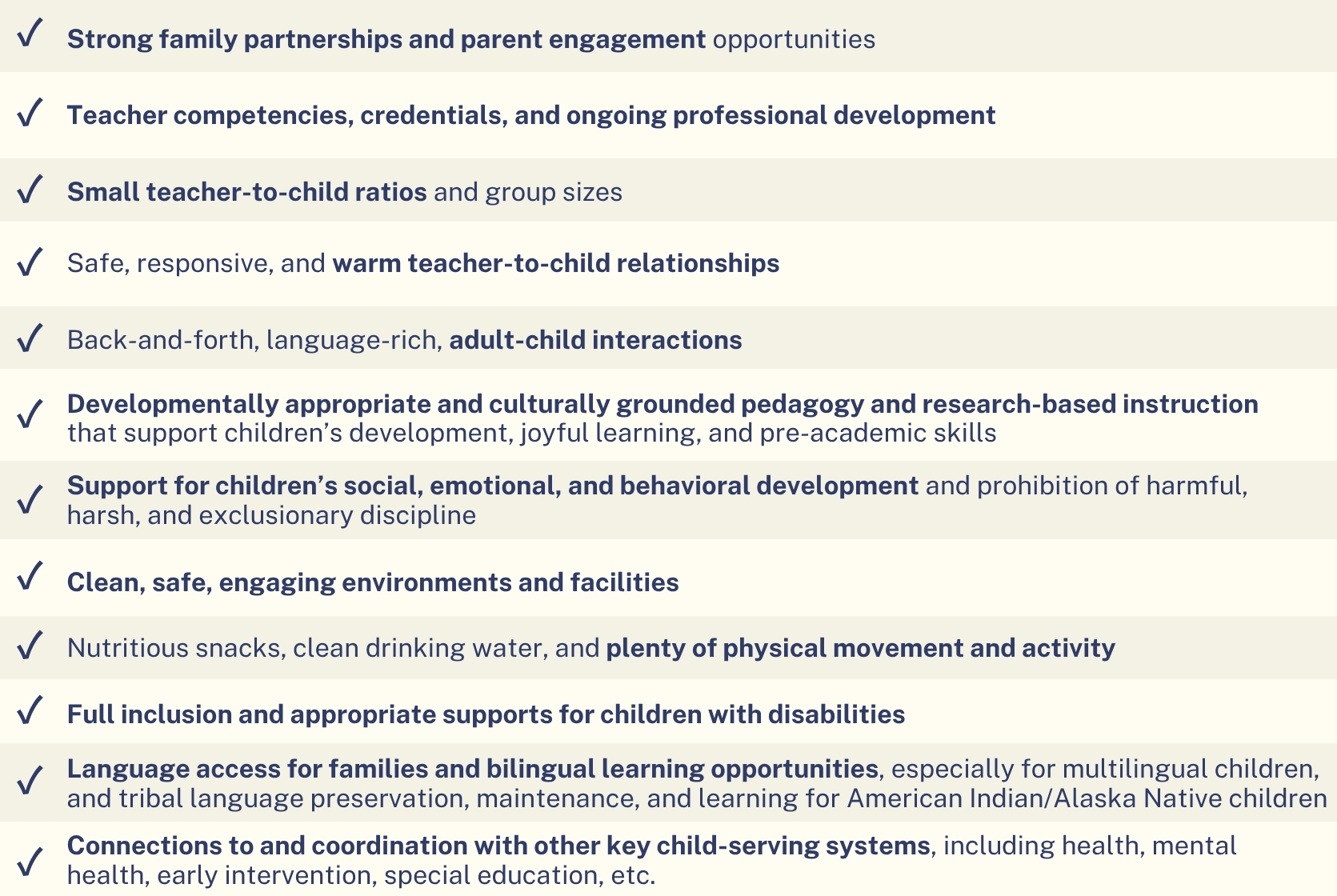
Establishing and enforcing quality standards rooted in inclusivity and cultural sensitivity can effectively dismantle regressive elements of state QRIS policies. Public option childcare quality standards grounded in equity can build the foundation for community‑driven, accountable governance, enabling families and providers to shape systems that genuinely reflect local priorities and needs (Figure D). Empowering and equipping communities to identify childcare gaps and understand families’ distinct needs—through councils, collaboratives, and trusted local champions—cultivates childcare‑friendly places and spaces grounded in shared values and collective stewardship.
FIGURE D: What factors contribute to “high-quality” early care and learning environments?
Case Studies
Head Start Program Performance Standards
Head Start/Early Head Start serves as a critical source of childcare for working families. The program provides safe and high-quality childcare spaces for low-income earning parents. Head Start is federally funded but a program’s day-to-day operations and administration occurs at the local level. Through program-specific policy councils, Head Start parents are granted access to and can participate in leadership level decisions like classroom curricula and budget allocations (Gibbs 2025). What’s more, Head Start programs are committed to individualizing services so that every child and family feels respected and valued. Head Start’s cultural competence principles offer a utilitarian blueprint for communities to consider as they assemble essential public infrastructure for caregiving spaces at the local level (HSMP). Fostering authentic relationships and offering stakeholders access to decision-making systems empowers families and enhances community childcare spaces.
Community-Led Spaces
Colorado’s Culturally Responsive Community Based Licensing program, focuses on delivering childcare licensing services rooted in competence, caring, and compassion while ensuring compliance (Allen et al. 2024). The model, housed at the Institute for Racial Equity and Excellence (IREE), supports community childcare providers throughout the licensing process. Licensors are recruited locally then culturally, linguistically, and racially matched with the providers they serve (Allen et al. 2024). All licensors participate in quarterly anti-bias and anti-racist trainings and the licensing agency hosts quarterly meetings with licensors to assure regulatory policies are interpreted and enforced clearly and consistently (Allen et al. 2024).
Wildflower Schools is a national network of childcare programs and micro-schools deeply rooted in the communities they serve, founded and operated by early educators (WFS). Storefronts, commercial suites, and flex-use spaces are transformed into joyful, intentionally designed early learning environments reflective of a community’s culture and childcare needs. The Wildflower Foundation raises and distributes startup capital and provides technical assistance resources to emerging schools and offers ongoing professional development, community, and connection to member schools.
Workforce
Barriers
Early childcare educators and providers are anchors in their communities, but childcare is not recognized as an essential service and, as a result, the workforce is chronically overworked and underpaid. By far the largest expense for childcare providers is wages. Providing childcare in licensed spaces is dynamic and labor-intensive, with adult-to-child ratios set by state governments to ensure the spaces childcare programs operate in are safe and nurturing environments. The quality of child-caregiver interactions is the most significant factor contributing to positive development outcomes for children (Hamre et al. 2014). The predominately female workforce reflects the racial, ethnic, and linguistic diversity of the children they serve (McLean et al. 2024). Providing high-quality care to young children requires skilled professionals that should earn wages reflective of their knowledge and experience, but the median workforce wage is $13 an hour (McLean et al. 2024). According to the Center for the Study of Child Care Employment (CSCCE), median early educator pay remains below what a single adult needs to meet basic living costs in every state (McLean et al. 2024). These staggeringly low wages undermine early educators’ financial stability, creating conditions where the workforce experiences higher rates of food insecurity and where 43 percent rely on social safety net programs—costs ultimately borne by public systems. (McLean et al. 2024).
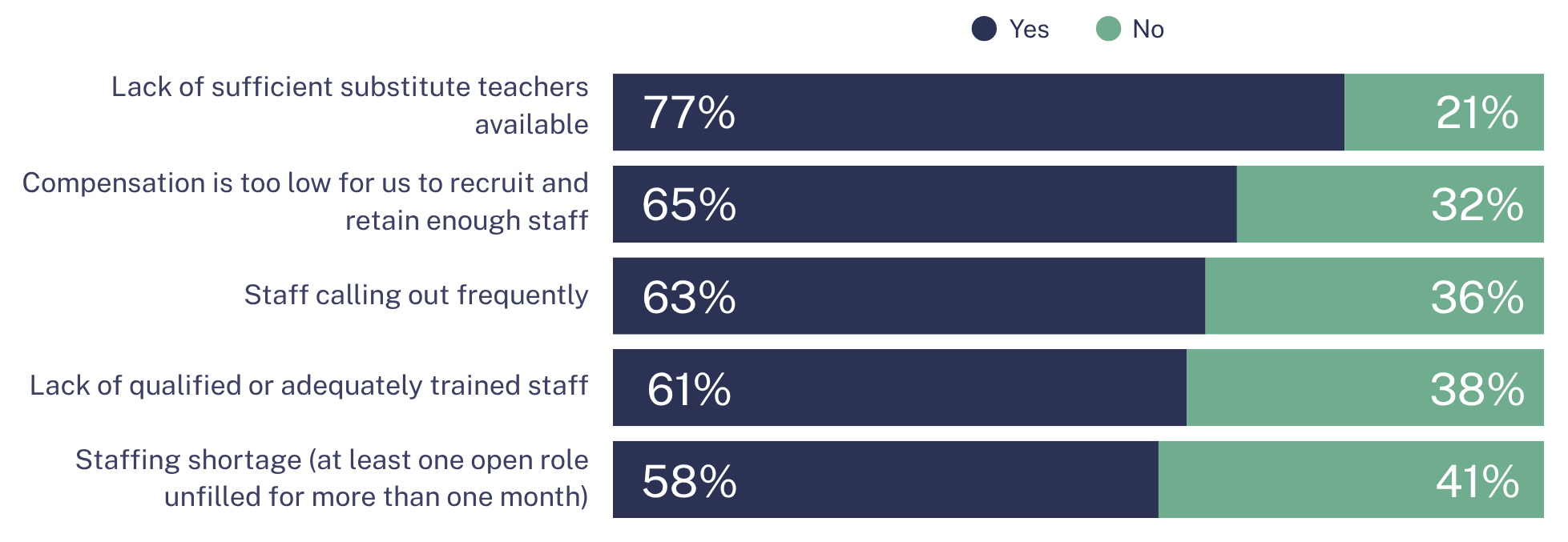
ECE employees often lack access to basic workplace benefits like health insurance and retirement plans typically offered to full time employees. These workforce conditions are undoubtedly rooted in systemic gender, class, race and ethnicity inequities. Unsurprisingly, the sector often experiences issues with staffing shortages as turnover is strongly correlated to low wages and burnout (Grunewald et al. 2022) (Figure E). The recent uptick in immigration enforcement has further exacerbated staff shortages as foreign-born caregivers shift toward less formal, less visible work arrangements (Herbst and Tekin 2025).
FIGURE E: Program Leaders Currently Report Outsized Staffing Challenges
https://www.naeyc.org/sites/default/files/wysiwyg/user-174467/2026_survey_brief.pdf
Implementation
Investing in support for caregivers in the U.S. will require social and political shifts that value caregivers as an integral part of the system. The ECE workforce is tasked with arguably the most important job: providing high-quality care to children, shaping their development and ultimately our collective future. Thus, they should be compensated accordingly. Public option childcare would fundamentally reshape the ECE workforce by offering access to the comprehensive benefits and institutional supports that federal employees receive. The financial security of a livable wage will tremendously help the countless childcare workforce professionals currently living at or below the poverty line. Teacher turnover rates are significantly lower when ECE employees earn higher wages and have access to compensation packages comparable to those offered by similarly qualified K-12 educators like healthcare and retirement benefits (Grunewald et al. 2022). Additionally, access to higher salaries will attract and retain more high-quality caregivers, forcing the private sector to offer more competitive compensation packages thereby strengthening the entire mixed-delivery system.
Public option childcare will enhance and standardize workforce satisfaction by creating new employment opportunities and improving workforce conditions: offering job security, economic mobility, career pathways, pay parity, and comprehensive benefits. By leveraging federal scale and funding, a public option can connect childcare workers to the public benefits they already qualify for but often do not receive, and provide shared administrative services and supports that small providers cannot currently afford like bookkeeping and facilities maintenance. This would reduce operational burdens and strengthen the financial stability of the workforce overall.
Case Studies
Strategic Workforce Investments
In 2023, Vermont passed Act 76, a childcare quality and capacity incentive. The bill made strategic investments in systemic utilization and parental choice thereby expanding access to appropriate childcare options that align with families’ needs, preferences, and circumstances like nonstandard hours and culturally competent, multilingual programming (Act 76 and Let’s Grow Kids). The anticipated enactment of S206 will make Vermont the first state to recognize early childhood education as a profession (S206, CCAoA 2025, and VT-AEYC). The bill creates a license to practice for roughly 6,500 early childhood educators working in regulated family childcare home programs and center-based programs creating access to increased pay, benefits, and professional development pathways, promoting a healthier and happier workforce.
In 2022, the District of Columbia’s government passed the Early Childhood Educator Pay Equity Fund (PEF), the first publicly funded program that brings ECE educators to pay parity with K-12 educators. The Office of the State Superintendent of Education worked closely with a task force of ECE workers to determine how the funds are distributed (OSSE). In its first year the program provided one-time payments ranging from $10,000 to $14,000 to ECE qualifying educators. In a 2025 Provider Survey, respondents reported that the program: helped to stabilize their businesses which also improved stability for the children in their care (Nikolopoulos et al. 2026); and without the compensation program, childcare would be more expensive and harder to find (Nikolopoulos and Greenberg 2026). In April 2026, Mathematica released a cost‑benefit analysis showing the PEF delivers clear economic value. Their findings state that in FY 2024, the program’s benefits exceeded its costs by $16 million, yielding an estimated social return on investment of 21 percent (Schochet and Gonzalez 2026). The study further reported that total estimated benefits to educators, facilities, and families reached $92.54 million, with families as the primary beneficiaries thanks to expanded access and measurable quality improvements (Schochet and Gonzalez 2026). And in a promising sign of continued commitment, the FY 2027 budget approved in July 2026 dedicated $73.5 million to the PEF, reinforcing the program’s momentum and long‑term impact (Grosso et al. 2026).
Community-Based Interventions
Neighborhood Villages, located in the Greater Boston area, is a model worthy of scaling nationally. The organization specializes in ground‑level, strategic interventions that strengthen capacity by furnishing its local workforce with a diverse and innovative menu of support services advancing sustainable, equity-driven systems (NV). Additionally, the nonprofit facilitates family access to the health services, wraparound supports, and material goods their children need. Funded through philanthropy, government grants, and public investment, Neighborhood Villages operates as both an innovation lab and a proof of concept demonstrating how community‑centered childcare solutions can take root and thrive (Compton 2022).
A public option would both expand the number of actual caregiving spaces and invest in improving existing spaces, without compromising quality, guaranteeing access and preserving parental choice. By targeting investments that rehabilitate and enrich existing spaces while also identifying and developing new spaces we can meet the demand and ameliorate a broken system.
Mobile Systems
Given the considerable childcare gaps and shortages nationwide, a thorough understanding of where deserts exist and why they form is critical for informed decision‑making. Expanding mobile childcare systems, services that bring care directly to children and their families, can help bridge these gaps in harder-to-reach areas. This section explores how mobile care systems could benefit three specific populations: rural communities, seasonal and migratory workers, and license-exempt caregivers.
The ideas explored in this section serve as a starting point, not a comprehensive list of constituencies who could gain from mobile care systems. Not every community will require a mobile approach; yet it is valuable to investigate novel solutions that can expand childcare to more families regardless of scale.
There are few existing models of mobile care systems in the U.S. This section leverages international case studies to expand our understanding of care delivery. These global examples provide a blueprint for innovating beyond traditional systems to support more underserved American families. Mobile care systems in the U.S. should be a complementary addition to systemic investment, not a replacement for more traditional forms of childcare.
“Without public investment that addresses childcare compensation and access to benefits, the market will continue to be unable to meet the urgent childcare supply, affordability, and accessibility needs of families and employers.”
Child Care Aware of America, 2025
Rural Communities
Barriers
Rural communities face some of the most acute childcare challenges in the country. Sparse population makes it harder to sustain licensed providers, geographic isolation limits access to the resources and infrastructure that urban and suburban markets take for granted, and workforce shortages are more severe when there are fewer workers to draw from in the first place. The result is that rural families often have fewer options, longer distances to travel, and less support than families in more densely populated areas (Moran 2025). As a result, childcare gaps in rural communities are more pertinacious and harder to resolve. In fact, the number of families living in licensed childcare deserts rose to 70 percent in rural areas in 2025 (Gibbs and Peeks 2026) (Figure F).
FIGURE F: Rural parts of the country continue to face more extreme licensed supply challenges relative to more populous areas, with 60 percent of micropolitan and 70 percent of noncore rural areas qualifying as licensed child care deserts
Percentage of children under age 6 in licensed child care deserts, by rurality
| Rurality | Population characteristics | # of counties | % of pop. | % of children under age 6 in child care deserts | |
| Large central metro | 1 million or more, with at least 250K residents of any principal city therein | 67 | 30.8% | 34.8% | |
| Large fringe metro | 1 million or more | 368 | 25.5% | 44.1% | |
| Medium metro | 250,000–999,999 | 395 | 21.2% | 48.4% | |
| Small metro | 50,000–249,999 | 356 | 8.8% | 54.0% | |
| Micropolitan | 10,000–50,999 | 658 | 8.4% | 60.5% | |
| Noncore | 2,500–5,000 or fewer | 1,300 | 5.4% | 70.8% |
https://www.americanprogress.org/article/americas-licensed-child-care-deserts/
Implementation
Any effective public option must address the unique needs, preferences, and circumstances of rural families. Temporary mobile facilities could decrease childcare deserts and provide invaluable flexibility to adapt as rural communities’ childcare needs evolve. The U.S. already has some of the political infrastructure to fund and implement this: programs like the Rural Community Development Initiative Grants provide technical assistance that could connect to funding from USDA Community Facilities Grants or Loans (USDA and HRSA) and a USDA report on rural childcare infrastructure emphasizes improving existing infrastructure and creating more options. The Rural Child Care Innovation Program (RCCIP) similarly offers a framework for community-led engagement to identify acute gaps and design programs matching families’ needs (FCF). Mobile childcare solutions will require uniform quality, health, and safety standards (e.g., licensing, ratios, egress, environmental standards, provider requirements, and insurance) grounded in the same principles that regulate public option physical sites, with added flexibility to accommodate the diverse range of vehicles suitable for childcare.
Case Study
Colombia’s Rural Care Buses
Publicly-funded childcare services in Bogotá, Colombia, provide free care for children, elders, and people with disabilities. From an initiative that started in 2020, there are now 27 Care Blocks, centralized facilities that provide free childcare and social services, across the city with the goal of reaching 45 by 2035. Approximately 75 percent of Bogotá’s land area is rural (TC). “Care Buses” are utilized to deliver the caregiving services offered in Care Blocks to rural and urban communities that are underdeveloped and/or geographically isolated. One of the two Care Buses, exclusively serves families residing in rural Bogotá districts: Ciudad Bolívar, Santa Fe, and Usaquén (CO).
Care Blocks and Buses are publicly-funded via Colombia’s National Care System and Bogotá’s District Care System. Based on an in-person presentation from Colombia’s Institute of Family Welfare, they claim to apply a social justice lens to expanding services by prioritizing remote and under-resourced areas. To ensure the country’s caregiving services reach those with the greatest need, locations for new Care Blocks and Buses are determined by vulnerability metrics based on national survey data. The Institute of Family Welfare also hosts a “children’s table” to build local accountability structures utilizing community-based research and learning directly from young people to better understand what they want to see in the care system.
Non-traditional Workers
Barriers
An estimated 40 percent of children use childcare during non-traditional work hours (e.g., early mornings, evenings, overnights, or weekends), and programs rarely offer care outside traditional weekday hours (ACF). For seasonal and migratory workforces (e.g., construction and landscaping, tourism and hospitality, and park and conservation work) job site locations can shift on a monthly basis or moment’s notice, meaning fixed facilities cannot always meet these families’ needs. Mobile care systems, deployed directly at job sites, offer an adaptable, cost-effective supply-building solution for these workers and their children where fixed infrastructure cannot reach. Even when this model has been tested, sustaining it has been a barrier. Wee Wagon was a unique mobile childcare unit designed to travel with workers at film festivals and shifting production locations (Valentini 2018). Despite strong demand and a clear proof of concept, Wee Wagon ultimately shut down due to unsustainable financing (Pritchard 2022). Innovative programs struggle to sustain themselves without ongoing, public investment.
Implementation
Piloting mobile systems for non-traditional workers should begin with qualitative data collection to understand these families’ needs, circumstances, and preferences. Head Start, for example, currently enrolls only about one-fifth of eligible children in its migrant and seasonal program. Without childcare, some parents face being pushed out of the workforce or children may be brought to worksites to wait in vehicles or risk exposure to hazardous conditions (Armario 2009). This gap is what mobile systems are positioned to fill. While Head Start broadly faces scrutiny under the current administration, there remains an opportunity to pilot mobile interventions for this population now, positioning the case for a future, more favorable political moment (Loewenberg 2026). Public-private partnerships offer the most logical pilot vehicle: investing in mobile units benefits traveling employers through a more present, productive workforce, and benefits families through increased earnings and quality of life.
Case Studies
Mobile Creches
Mobile Creches, a nonprofit childcare organization supports India’s migrant workforce operating as fixed on-site facilities near construction, hospitality, and manufacturing worksites and some sites are designed to move with the job supporting work alongside road and infrastructure crews as the work progresses. One of India’s largest childcare organizations, Mobile Creches is a clear example of childcare infrastructure built to migrate with seasonal and migratory workforces (Habib 2022).
Migrant and Seasonal Head Start
There is no comparable U.S. example of mobile childcare units serving this population, but the National Ag Families Head Start Association (NAFHSA), formerly the National Migrant and Seasonal Head Start Association, has operated in 34 states since 1969 (NAFHSA). While the facilities themselves don’t move, the program flexibly adjusts locations and classroom counts based on where families live and work such as shifting with crop timelines in North Carolina (EdNC). This adaptable, publicly-funded model is worth scaling, as mobile childcare units serve as a complementary component in ensuring continuity of care and expanding access to wraparound services.
License-exempt Caregivers
Barriers
Family, Friend, and Neighbor (FFN) caregivers and stay-at-home parents often manage workloads exceeding a traditional 40-hour week as primary providers with limited community support. FFN caregivers, particularly within rural, immigrant, and people-of-color communities, are often the only or most trusted childcare option (Home Grown) (Figure G). Working beyond the boundaries of licensed childcare means these caregivers rarely receive the recognition, support, or moments of respite that their essential work demands.
FIGURE G: The Types of Child Care Arrangements U.S. Children Attend
The vast majority of U.S. children (79%) attend some type of child care, with many attending more than one type.
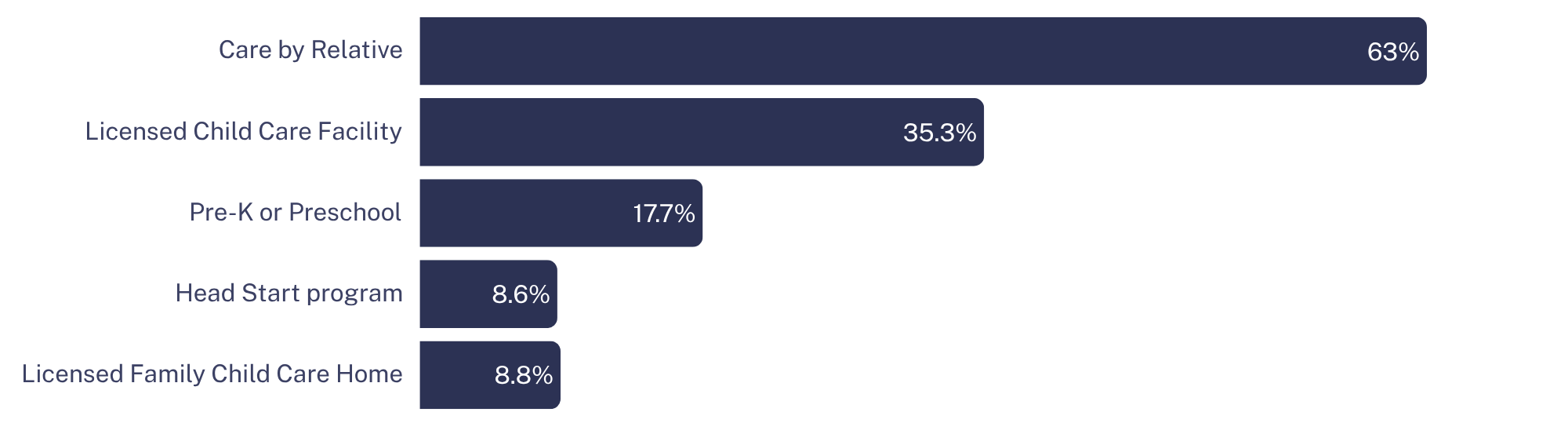
https://www.newamerica.org/insights/innovations-for-universal-child-care/i-introduction-the-decades-long-deepening-of-a-child-care-crisis/
Implementation
Regular visits from a mobile care system could give these caregivers something invaluable: time to attend healthcare appointments, pursue employment or education, or simply rest, while offering children new opportunities for social interaction. A related population—families waiting on early intervention diagnosis appointments, which can take anywhere from two months to three years amid rising demand for developmental screening—could similarly benefit from mobile care access (UARK and Zablotsky et al. 2023). Building this kind of support will require a broader shift toward treating caregiver well-being as a collective responsibility, since caregiver stress and stability directly shape early childhood experiences and outcomes.
Case Study
Illuminate Childcare Colorado
The scope of mobile childcare models in the U.S. is limited. Illuminate Childcare Colorado is an exception, offering families a comprehensive approach to community care in the Denver metro-San Luis Valley area (ICC). On-site mobile classrooms deliver quality childcare and, through public and private partnerships, help caregivers navigating complex life situations access wraparound supports. This publicly-funded mobile model strengthens the childcare ecosystems and families they serve.
RecommendationsRecommendations
Based on the evidence presented in this paper, we recommend federal, state, and local policymakers, as well as philanthropies embark on the following pathways to build toward a childcare public option:
- Congress should authorize and appropriate a dedicated federal funding stream for public option childcare infrastructure. This means treating childcare facilities as essential public infrastructure on par with the postal service or public libraries rather than continuing to fund care solely through demand-side subsidies like CCDF.
- Congress should consolidate early childcare and education governance into one federal agency and build a unified, cross-program data-collection system to map provider capacity, family needs, and supply gaps, including underserved infant-toddler slots, nonstandard-hour care, and disability supports, to guide where new public option facilities and capital investment should go.
- The newly established early childcare and education federal agency should establish uniform, enforceable national baseline standards for health, safety, and quality across the mixed-delivery system, modeled on the Head Start Program Performance Standards, including basic health and safety infrastructure requirements such as natural light, clean water, air quality, and adequate square footage per child.
- States should build public option childcare facilities in licensed childcare deserts and use every available financing tool (e.g., CDFI financing partnerships, co-location strategies with affordable housing, and community planning tools like master plans and capital improvement plans) to get those facilities built faster and more affordably.
- States should pilot mobile childcare systems for populations fixed facilities cannot reach, with a focus on rural communities, seasonal and migratory workers, and license-exempt caregivers, building on domestic frameworks like USDA rural development grants and operational lessons from existing mobile health unit models.
- States should invest directly in workforce compensation and stability, by creating dedicated public funds that provide wage supplements to childcare workers based on their qualifications and years of experience and build a path to create pay parity with K-12 educators.
- Philanthropy should fund pilots, data collection, and cross-sector partnerships that de-risk this work before public dollars scale it, including qualitative research on non-traditional workers’ childcare needs, seed funding for mobile system pilots, and cross-sector working groups that connect workforce boards, employers, and community organizations to identify and improve funding structures, pilot sites, and operational models for public-private partnership.
Conclusion
We know what children need. We know what parents, families, and providers need. We know what communities need. Yet, our society has been trapped in a self-perpetuating broken business model rooted in systemic discrimination and a culture of low expectations for the spaces our children and their caregivers occupy. It doesn’t have to be this way.
High‑quality childcare spaces aren’t anomalies: they’re emerging in promising pockets across the country offering tangible examples of potential when communities invest in childcare spaces and the workforce that supports them. We seek to grant all families equitable access to quality care through a public option, existing alongside private programs, as a part of a broader, federally funded mixed-delivery system that beholds childcare spaces as essential public infrastructure, reaching children across communities, and adequately compensating the workforce with thriving wages and support.
Implementing bold ideas like these will accelerate the path to universal public childcare in the U.S.
Appendix
Additional Supply Case Studies
Initiatives Optimizing data
Colorado’s Office of the State Architect developed a geographical information system (GIS) map application with unique layers that identify unused parcels, state-owned parcels, and state facilities by square feet (CO-OSA and ArcGIS). The feature modernizes a typically cumbersome task making it easier to evaluate underutilized existing infrastructure as potential childcare spaces. The state also passed HB 24-1237, a grant program that provides funding for local governments to hire experts to assess community childcare needs and adopt policies, programs, review procedures, land use codes, and other local laws that promote the development of childcare facilities and family childcare homes (HB 24-1237).
The Center for Early Learning Funding Equity (CELFE), in partnership with NORC at the University of Chicago, recently piloted a new approach to measure the community’s childcare needs in Lake County, Illinois. The program highlights how more detailed community data can disseminate the demographic precision required to best assess needs and determine the types of services families want. This type of granular, local-level information is invaluable for community planning (CELFE).
A non-profit in New York City is petitioning the Department of Buildings to make non-residential space discoverable, in its public data, the same way residential space is (Verada). This small technical change could have a major impact: facilitating childcare operators’ ability to search for and identify compliant spaces earlier in the planning process can stabilize financing, lower build-out costs, and expedite access to licensed slots.
Additional Mobile Supply Case Studies
Scandinavian Preschool Buses
Mobile preschool buses pick up children (typical ages 3 to 5) and provide care both inside mobile units and outdoors for destination-based exploration. These mobile preschool buses pilot programs began in Denmark to address the nation’s lack of quality childcare spaces. The Denmark model is highly regarded for program quality, curricula, and emphasis on child development and learning in nature-as-a-second-classroom (Gustafson 2015). Today, mobile preschool models are also found in Norway and Sweden. The models are anchored in Nordic countries’ cultural values around the benefits of exploratory learning, free play, physical activity, and outdoor classrooms on children’s well-being (Berkhuizen 2020 and Largo-Wight et al. 2018).
The U.S. differs fundamentally from Sweden, they still offer an influential model for what could be possible stateside. Mobile preschool buses are a more versatile and cost-effective childcare option, minimizing the need for more rigid physical infrastructure. Mobile childcare models could benefit rural areas where childcare needs might fluctuate among families working nontraditional hours or across multiple sites. International mobile preschools transport children directly to and from their homes. In the U.S. this model could reduce the transportation barriers like unreasonably long commutes and lack of public infrastructure currently contributing to childcare inaccessibility in rural communities.
Mobile Health Units
The closest domestic analog is the mobile health clinic. These clinics‑on‑wheels—usually repurposed vans or trucks—help health agencies reach people who otherwise go without care. For example, Washington state’s on-site Mobile Community Service Offices (CSOs) help individuals access health care systems and support services like food and childcare assistance (RHIH); an Arizona-based nonprofit delivered preventive oral health care to thousands of children in two rural counties (Rural Health); and mobile health units provide pregnancy-related and preventive services in Texas’s pastoral and perilous Rio Grande Valley (RHIH).
Care Buses in Colombia (especially for license-exempt caregivers)
As previously mentioned, Care Buses bring childcare services to rural areas. In addition to childcare, both Care Blocks and Care Buses also provide resources for caregivers, like education, employment coaching, health care, and personal time for rest and self-care (Manzanas del cuidado). They visit six different neighborhoods in Colombia twice a week. They also provide a platform for parents to connect and communicate through a shared WhatsApp group (Sistema de cuidado). The Care Block and Bus models deliver combined services to caregivers and their children conveniently and efficiently. Research shows that community care for childcare providers improves outcomes for the families they care for: decreases in parental distress and conflict, and augments relationships within families by modeling positive care partnerships inside the home and continuity of care across the formal and informal caregiving spaces (Cook et al. 2023).
In conversation with Colombia’s former Women’s Secretariat who was integral in implementing their national care system, Laura Bordamalo outlined how both Care Blocks and Buses were designed under the goal of reducing caregiver burden. This publicly-backed desire to care for the caregivers was borne of Colombia’s feminist movement and rights-based care frameworks that anchored care as a political priority. Colombia’s approach to care across the lifespan (i.e., children, elderly, people with disabilities, and their caregivers) underpins the political and social values required to position caregiver relief as a public responsibility, not an individual one.
Bibliography
Alibadi, Tuqa. 2025. Real-Time Child Care Data in Iowa: A Digital Service Network Spotlight. Digital Service Network (DSN) and Beeck Center for Social Impact and Innovation.
Allen, Rosemarie, Eric Z. Bucher, Shantel Meek, Brittany Alexander, Afua Ameley-Quaye, Xigrid Soto-Boykin, Darielle Blevins, and Mario Cardona. 2024. “Reimagining state child care licensing: Improving the foundation for quality and equity in early care and education environments.” The Children’s Equity Project (CEP) at Arizona State University.
https://cep.asu.edu/resources/reimagining-state-childcare-licensing
Armario, Christine. 2009. “For Migrant Children, Out of Fields and Into Head Start.” EducationWeek.
Berkhuizen, Carina. 2020. “Playing bus in a bus – children transforming spaces within a mobile preschool into resources in place-making fantasy play.” International Journal of Play. Volume 9, Issue 2: 182–201.
https://doi.org/10.1080/21594937.2020.1778270
Bowley, Taylor. 2025. “The many costs of childcare: Childcare costs are rising faster than overall inflation, straining family budgets and possibly prompting workforce exits.” Bank of America Institute.
https://institute.bankofamerica.com/economic-insights/childcare-costs.html
Child Care Aware of America (CCAoA). N.d. State-By-State Child Care Affordability and Availability Data.
https://data.childcareaware.org/affordability-and-availability
Child Care Aware of America (CCAoA). 2025. Economics & Child Care: Where Are We Now and Where Do We Go? https://www.childcareaware.org/wp-content/uploads/2025/07/Full-Report-Economics-and-Child-Care-Where-Are-We-Now-and-Where-Do-We-Go.pdf
Child Care Aware of America (CCAoA). 2025. Child Care in America: 2025 Price & Supply. https://info.childcareaware.org/price-and-supply-2025
Child Care Aware of America (CCAoA). 2025. State Session Round Up: Summer 2025.
https://info.childcareaware.org/hubfs/State-Session-Round-Up-Summer-2025.pdf
Child Care Aware of America (CCAoA). 2022. Demanding Change: Repairing Our Child Care System.
https://www.childcareaware.org/demanding-change-repairing-our-child-care-system/
Children’s Investment Fund (CIF). N.d. Why Quality Space Matters. Community Economic Development Assistance Corporation (CEDAC).
https://cedac.org/cif/technical-assistance/why-quality-space-matters
Cohn, Jonathan. 2026. “How to Break the Fifty-Year Stalemate on Childcare Policy.” The Bulkwark. https://www.thebulwark.com/p/how-to-break-the-fifty-year-stalemate-on-childcare-policy-nixon-biden-project-2029
Compton, K.C. 2022. “Neighborhood Villages: Boston-Based Child Care Innovation Lab for Solutions that Can Scale.” The74.
Cook, Kyle DeMeo, Eleanor Fisk, Caitlin McPherran Lombardi, and Kevin Ferreira van Leer. 2023. “Caring for Whole Families: Relationships Between Providers and Families During Infancy and Toddlerhood.” Early Childhood Education Journal. Volume 52: 921-933.
https://doi.org/10.1007/s10643-023-01491-x
Dormitory Authority of the State of New York (DASNY). 2025. “Governor Hochul Announces $100 Million Child Care Capital Construction Funding Program to Increase Availability of Quality Care and Expand Child Care Capacity Statewide.”
https://www.dasny.org/news/2025/governor-hochul-announces-100-million-child-care-capital-construction-funding-program and https://www.dasny.org/sites/default/files/inline-files/4CFP%20RFA%20Final%2012-1-2025.pdf
Ferrie, Joseph P., Claudia Goldin, and Claudia Olivetti. 2024. “Mobilizing the Manpower of Mothers: Childcare under the Lanham Act during WWII.” National Bureau of Economic Research (NBER) Working Paper No. 32755 (July 2024, Revised January 2025).
https://doi.org/10.3386/w32755
First Children’s Finance (FCF). N.d. Rural Child Care Innovation Program (RCCIP).
https://www.firstchildrensfinance.org/for-communities/rural-child-care-innovation-program
First Five Years Fund (FFYF). 2026. FFYF Statement on H.R.7726: Concerns and Recommendations around Accountability and Access. https://www.ffyf.org/2026/06/02/ffyf-statement-on-h-r-7726-concerns-and-recommendations-around-accountability-and-access/
First Five Years Fund (FFYF). 2026. Understanding Improper Payments: Child Care and Development Fund.
https://www.ffyf.org/2026/06/01/understanding-improper-payments/
First Five Years Fund (FFYF). 2026. National Poll Shows Strong Bipartisan Support for Federal Child Care Programs. https://www.ffyf.org/2026/01/28/new-national-poll-shows-strong-bipartisan-support-for-federal-child-care-programs/
First Five Years Fund (FFYF). 2025. Statement: National Defense Authorization Act Includes Critical Child Care Support for Military Families.
First Five Years Fund (FFYF). 2025. Federal Investments are the Foundation for State and Local Early Care and Education Programs.
https://www.ffyf.org/2025/06/10/federal-foundation/
Federal Register (FR). 2026. Reducing Federal Burden for Head Start Programs: A Proposed Rule by the Children and Families Administration on 08/07/2026. 2026. Department of Health and Human Services, Administration for Children and Families. 2026-16134 (91 FR 51248). https://www.federalregister.gov/d/2026-16134
Federal Register (FR). 2026. Restoring Flexibility in the Child Care and Development Fund (CCDF): A Rule by the Health and Human Services Department on 05/12/2026. Department of Health and Human Services. 2026-09382 (91 FR 25796).
https://www.federalregister.gov/d/2026-09382
Federal Register (FR). 2024. Improving Child Care Access, Affordability, and Stability in the Child Care and Development Fund (CCDF): A Rule by the Health and Human Services Department on 03/01/2024. Department of Health and Human Services. 2024-04139 (89 FR 15366). https://www.federalregister.gov/d/2024-04139
Federal Register (FR). 2024. Supporting the Head Start Workforce and Consistent Quality Programming: A Rule by the Health and Human Services Department on 08/21/2024. Department of Health and Human Services. 2024-18279 (89 FR 67720). https://www.federalregister.gov/d/2024-18279
Gibbs, Hailey. 2025. Debunking Myths About Head Start: How the Program Promotes Opportunity and Strengthens Families, Communities, and Economies. Center for American Progress (CAP).
Gibbs, Hailey and Casey Peeks. 2026. America’s Licensed Child Care Deserts. Center for American Progress (CAP).
https://www.americanprogress.org/article/americas-licensed-child-care-deserts
Governor Kath Hochul. 2026. “Governor Hochul Announces Investments to Deliver Universal Child Care for New York Children Under Five – Governor & Mayor Mamdani to Launch Free Child Care for Two-Year-Olds in NYC.” New York State.
Grosso, David P., Jon S. Boiler, and Brian J. Coen. 2026. “DC Council Passes Final FY 27 Budget Support Act.” ArentFox Schiff LLP.
https://www.afslaw.com/perspectives/alerts/dc-council-passes-final-fy-27-budget-support-act
Grunewald, Rob, Vanessa Palmer, and Ryan Nunn. 2022. “Examining teacher turnover in early care and education.” Federal Reserve Bank of Minneapolis.
https://www.minneapolisfed.org/article/2022/examining-teacher-turnover-in-early-care-and-education
Gustafson, Katarina and Danielle van der Burgt. 2015. “Being on the move: Time-spatial organisation and mobility in a mobile preschool.” Journal of Transport Geography. Volume 46: 201-209.
https://doi.org/10.1016/j.jtrangeo.2015.06.023.
Gutierrez, Laura Valle and Julie Kashen. 2025. “Still Unaffordable: Child Care’s Rising Prices, Stretched Supply, and Staffing Shortages.” The Century Foundation (TCF).
Habib, Jacky. 2022. “These Mobile Nurseries Are Helping Migrant Workers in India Access Child Care.” Global Citizen.
https://www.globalcitizen.org/en/content/mobile-creches-child-care-india
Hamre, Bridget, Bridget Hatfield, Robert Pianta, and Faiza Jamil. 2014. “Evidence for General and Domain-Specific Elements of Teacher–Child Interactions: Associations With Preschool Children’s Development.” Child Development. Volume 85, Issue 3: 1257-1274. https://doi.org/10.1111/cdev.12184
Harvard University Center on the Developing Child. 2016. 8 Things to Remember about Child Development.
https://developingchild.harvard.edu/resources/briefs/8-things-remember-child-development
Head Start Multicultural Principles (HSMP). 2012. “Revisiting and Updating the Multicultural Principles for Head Start Programs Serving Children Ages Birth to Five: Addressing Culture and Home Language in Head Start Program Systems & Services.” Early Head Start National Resource Center @ Zero To Three.
https://www.ecmhc.org/documents/Final_Head_Start_Multicultura_Principles_8.28.12.pdf
Herbst, Chris M. and Erdal Tekin. 2025. The Impact of Increased ICE Activity on the Child Care Workforce and Mothers’ Employment. New America.
https://www.newamerica.org/insights/impact-of-increased-ice-activity
Home Grown. 2026. Child Care Fraud Is a False Narrative. https://homegrownchildcare.org/child-care-fraud-is-a-false-narrative/
Largo-Wight, Erin, Caroline Guardino, Peter S. Wludyka, Katrina W. Hall, Jeff T. Wight, and Julie W. Merten. 2018. “Nature contact at school: The impact of an outdoor classroom on children’s well-being.” International Journal of Environmental Health Research. Volume 28, Issue 6: 653–666. https://doi.org/10.1080/09603123.2018.1502415
Local Initiatives Support Corporation (LISC). 2025. Building Innovation for Child Care Policy Recommendations.
https://www.lisc.org/our-resources/resource/building-innovation-child-care-policy-recommendations
Local Initiatives Support Corporation (LISC). 2022. Child Care Regulations by State: Lighting Variations.
https://www.lisc.org/our-resources/resource/child-care-regulations-state-state
Loewenberg, Aaron. 2026. “The Quiet Dismantling of Head Start: How the Trump Administration is Using Regulation to Reshape a Program It Can’t Eliminate.” New America.
Lopez, C. Todd. 2025. “DOD Launches Child Care Expansion Initiative, Provides More Options to Military Families.” U.S. Department of War.
Meek, Shantel, Darielle Blevins, Brittany Alexander, Tunette Powell, Xigrid Soto-Boykin, and Mario Cardona. 2026. “Lowering the Bar: An Analysis of How Replacing Head Start Standards with State Child Care Licensing Weakens Early Learning Across the United States.” The Children’s Equity Project (CEP) at Arizona State University. https://cep.asu.edu/resources/An-Analysis-of-How-Replacing-Head-StartStandards-with-State-Child-Care-Licensing-Weakens-Early-Learning-Across-the-United-States
Mickelson, Sara. 2026. “How to screw up universal childcare.” The Highlight. Vox. https://www.vox.com/the-highlight/489750/universal-child-care-new-mexico-demand-supply
Military Child Care (MCC). N.d. Military Child Care in Your Neighborhood (MCCYN).
https://public.militarychildcare.csd.disa.mil/mcc-central/mcchome/mccyn
Military Child Care (MCC). N.d. Child Care in Your Home (CCYH).
https://public.militarychildcare.csd.disa.mil/mcc-central/mcchome/child-care-in-your-home
Minnesota (MN) Department of Children, Youth, and Families (DCYF). 2026. Facts First: The real story on services that support Minnesotans.
https://dcyf.mn.gov/facts-first
Moran, Meredith. 2025. “Rural counties have options to bring childcare to their communities.” National Association of Counties (NACO).
https://www.naco.org/news/rural-counties-have-options-bring-childcare-their-communities
McLean, Caitlin, Lea J. E. Austin, Anna Powell, Sophia Jaggi, Yoonjeon Kim, Jenna Knight, Silvia Muñoz, and Marisa Schlieber. 2024. Early Childhood Workforce Index – 2024. Center for the Study of Child Care Employment (CSCCE), University of California, Berkeley.
National Association for the Education of Young Children (NAEYC). 2020. Developmentally Appropriate Practice: A Position Statement of the National Association for the Education of Young Children.
https://www.naeyc.org/resources/position-statements/dap/principles
National Defense Authorization Act (NDAA). 2025. Summary of the Fiscal Year 2025 National Defense Authorization Act (NDAA). U.S. Senate Committee on Armed Services.
https://www.armed-services.senate.gov/imo/media/doc/fy25_ndaa_conference_executive_summary.pdf
National Women’s Law Center (NWLC). 2026. Trump Administration Finalizes Rule that Raises Costs for Families and Destabilizes Child Care System.
Nikolopoulos, Elli, Justin B. Doromal, Heather Sandstrom, and Erica Greenberg. 2026. DC’s Early Childhood Educator Compensation Program Helps Stabilize Child Care Businesses. Urban Institute.
Nikolopoulos, Elli and Erica Greenberg. 2026. Three Things DC’s New Mayor and Council Need to Know About the District’s Early Educator Compensation Program. Urban Institute.
Office of Children and Family Services (OCFS). N.d. Child Care Capital Construction Funding Program (4CFP). State of New York.
https://ocfs.ny.gov/programs/childcare/grants/construction-fund
Organisation for Economic Co-operation and Development (OECD). 2026. OECD Family Database: PF3.1.Public spending on early childhood education and care.
Peeks, Casey. 2024. Early Childhood Education: Setting a Foundation for All Children To Thrive. Center for American Progress (CAP).
Peter G. Peterson Foundation (PGPF). 2026. “The United States Spends More on Defense than the Next 6 Countries Combined.”
Porter, Toni and Juliet Bromer. 2020. Delivering services to meet the needs of home-based child care providers: Findings from the director interviews sub-study of the National Study of Family Child Care Networks. Chicago, IL: Herr Research Center, Erikson Institute.
Powell, Anna, Sarah Thomason, and Ken Jacobs. 2019. “Investing in Early Care and Education: The Economic Benefits for California.” UC Berkeley Labor Center. https://laborcenter.berkeley.edu/investing-early-care-education-economic-benefits-california/
Prenatal-to-3 (PN3) Policy Impact Center . 2025. The History of Child Care Policies: Implications for Equitable Implementation. Peabody College of Education and Human Development, Vanderbilt University. https://pn3policy.org/wp-content/uploads/2026/01/The-History-of-Child-Care-Policies.pdf
Pritchard, Tiffany. 2022. “Adventures in Festival Babysitting: The Need for Day Care at Film Festivals.” Filmmaker Magazine.
ReadyNation. 2023. $122 Billion: The Growing, Annual Cost of the Infant-Toddler Child Care Crisis. Council for a Strong America.
Roth, William. 1976. “The Politics of Daycare: The Comprehensive Child Development Act of 1971.” Institute for Research on Poverty, University of Wisconsin-Madison. https://www.irp.wisc.edu/publications/dps/pdfs/dp36976.pdf
Schochet, Owen and Katie Gonzalez. 2026. Early Childhood Educator Pay Equity Fund (PEF): Do Economic Returns Change Over Time? Mathematica.
Schulte, Brigid and Elliot Haspel. 2026. “The Care Disconnect: Americans Misjudge Care Realities, But Know Families Need Help.” New America.
https://www.newamerica.org/insights/the-care-disconnect
Small, Shira, Rachel Wilensky, and Stephanie Schmit. 2026. How the First Year of the Trump Administration Undermined Child Care and Early Education. The Center for Law and Social Policy (CLASP).
https://www.clasp.org/publications/fact-sheet/trump-admin-undermine-child-care-early-ed-programs-25
Smith, Linda K. and Anubhav Bagley. 2026. “The National Child Care Gap: A Problem That is Costing Everyone Measuring Access, Workforce Impact, and the Cost of Inaction.” The Child Care Trust.
https://www.childcaretrust.org/resources/national-child-care-gap
Stienon, Audrey and Melissa Boteach. 2024. Children Before Profits: Constraining Private Equity Profiteering to Advance Child Care as a Public Good. National Women’s Law Center (NWLC) and Open Markets Institute.
https://nwlc.org/wp-content/uploads/2024/05/Children-Before-Profits-WEB.pdf
The White House (WH). 2026. Establishing The Task Force to Eliminate Fraud. Executive Order 14395.
U.S. General Services Administration (GSA). 2003. Child Care Center Design Guide. PBS-100.
https://www.gsa.gov/system/files/designguidesmall.pdf
U.S. Government Accountability Office (GAO). 2026. “Military Child Care: DOD Should Communicate More Clearly with Providers in the Fee Assistance Program.” GAO-26-107827.
https://www.gao.gov/products/gao-26-107827
Valentini, Valentina I. 2018. “Moms-in-Film Finds Parenting Solutions for Industry Workers With Long Hours.” Variety.
https://variety.com/2018/artisans/production/moms-in-film-helps-industry-parents-1202725725
Wildflower Schools. N.d.
https://www.wildflowerschools.org
Woods, Lea and Julie Kashen. 2026. “States Leading on Child Care Affordability as Trump Administration Tries to Take Funds Away.” The Century Foundation (TCF).
Workman, Simon and Rebecca Ullrich. 2017. Quality 101: Identifying the Core Components of a High-Quality Early Childhood Program. Center for American Progress (CAP).
Zablotsky, Benjamin, Amanda E. Ng, Lindsey I. Black, and Stephen J. Blumberg. 2023. “Diagnosed Developmental Disabilities in Children Aged 3-17 Years: United States, 2019-2021.” NCHS Data Brief. 473:1-8. PMID: 37440277
https://pubmed.ncbi.nlm.nih.gov/?term=Ng+AE&cauthor_id=37440277
Zero To Three (ZTT). 2023. The Case for Better Compensation of Early Educators.