Guaranteed Income
Cash Works. So Do Its Recipients.
09. 02. 2026
What happens to work when people receive a guaranteed income?

A common question about cash programs is how they impact work. This memo examines how guaranteed income affects employment by reviewing employment outcomes from over 40 cash pilots across the United States, with data from randomized controlled trials (RCTs), quasi-experimental designs, and firsthand reports from program participants.
From this synthesis, we found that cash strengthens—not undermines—employment. Our findings, along with policy recommendations to accelerate cash’s positive impact on work, are below.
Finding #1: More people work full-time
Full-time work among cash pilot participants increased substantially in nearly 60 percent of programs with relevant findings, and those benefits often persisted after the pilots ended.
- Full-time employment among participants increased 10 percentage points over the course of a twelve-month pilot in Ithaca, NY, and remained higher among this group than the control group six months later.
- During a pilot in Seattle, WA, employment nearly doubled, rising from 37 percent to 66 percent from its beginning to its end.
- In Saint Paul, MN, employment increased from 49 percent to 63 percent between when the pilot began and six months after it ended.
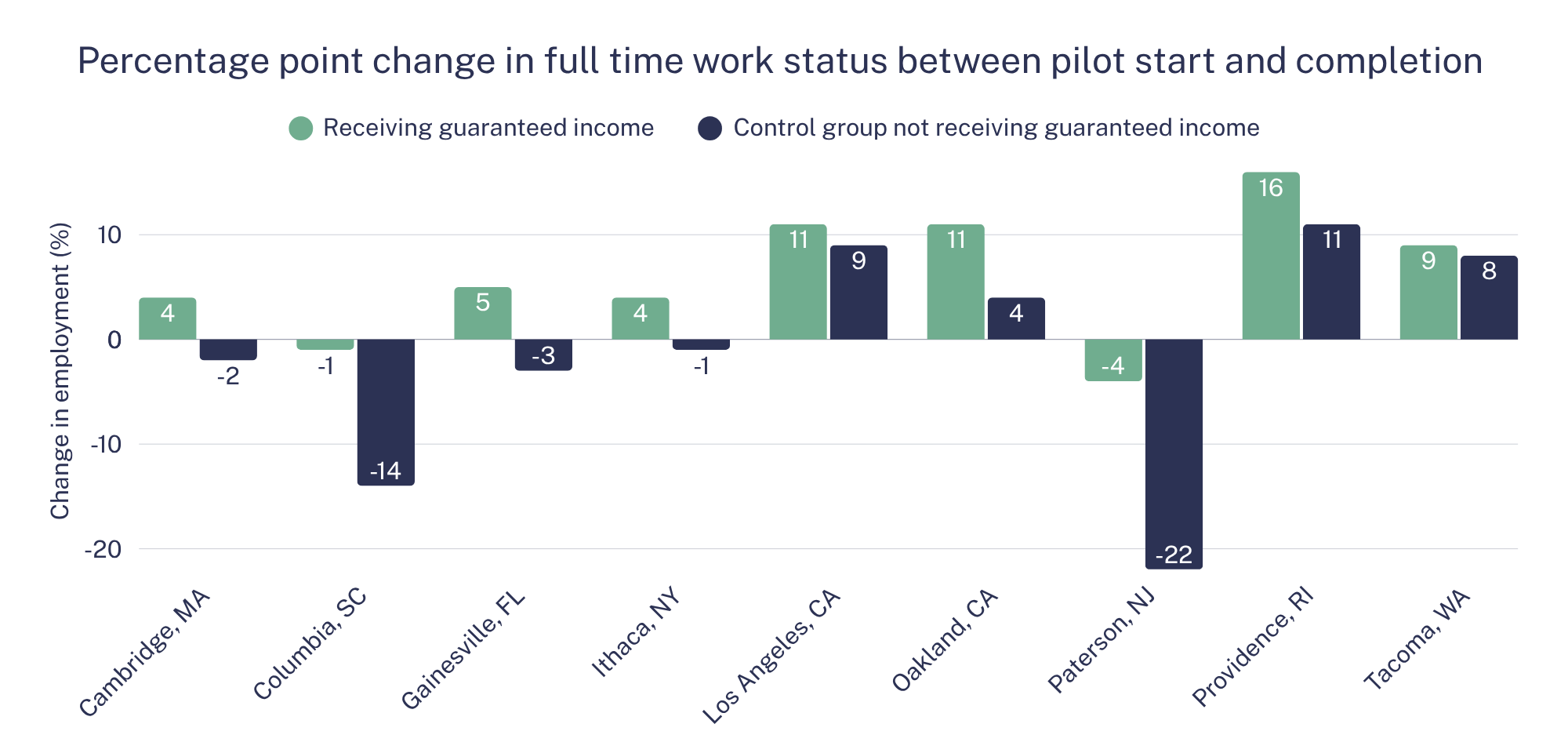
Individuals who received cash were more likely to see their full-time employment improve or hold steady than the control group who did not receive cash. The chart above represents the percentage-point change in full-time employment, from start to finish, for nine pilots nationwide.
- Cash reduces barriers to work, like transportation costs, allowing participants to invest more time and resources into their jobs or job search. Guaranteed income (GI) can also help defray childcare costs as lack of affordable childcare remains a substantial barrier to employment, as evidenced across pilots and populations in Cambridge, MA, Gainesville, FL, Oakland, CA, and more.
- GI supported faster transitions from education to employment.
- For instance, parents in Santa Fe, NM who were enrolled in community college and received GI increased their full-time employment by 19 percentage points between the start of the pilot and six months after it ended.
- In New Orleans, LA, a pilot targeting young people disconnected from work or school saw employment rise by 16 percentage points, with many reporting that the cash gave them the financial freedom to pursue training programs and internships.
Finding #2: Workers find higher-paying jobs with benefits
Pilot participants across regions report higher earnings and better workplace benefits when receiving cash.
Pilot participants in Austin, TX, Arlington, VA, and Seattle, WA alike reported finding new jobs with higher pay.
- In Arlington, participants’ monthly median income from work increased 36 percent, compared to a 9 percent increase for the control group.
- In Seattle, cash improved access to workplace benefits. Among the nearly two-thirds of participants who found new jobs during the pilot, health coverage increased 13 percentage points and access to a retirement plan nearly tripled.
- In other regions, including Newark, NJ, Tacoma, WA, and Columbia, SC, participants experienced a marked reduction in income volatility, supporting their financial stability.
Finding #3: Small business owners benefit
Direct cash provided to home-based childcare providers helps them keep their doors open.
- In Colorado, a pilot that provided $500 to home-based childcare providers per month reduced the share of providers who were considering leaving the field by over 19 percentage points.
- Against the backdrop of a major national childcare shortage, which has outsized impacts on lower-income parents’ ability to engage in paid work, this finding underscores the power of more direct financial support to childcare workers.
- While GI is no substitute for raising wages, it could play an important role in stabilizing the childcare sector.
Direct cash provides breathing room for entrepreneurs and gig-workers
In Ann Arbor, MI, a pilot targeting gig workers and entrepreneurs with low incomes found that monthly payments gave participants the breathing room to invest in their work, from purchasing equipment to launching new ventures, while reducing the financial stress that otherwise pulls self-employed workers away from their businesses.
Finding #4: Workers acquire new skills
Pilots serving a range of populations reported that the extra cash made it possible for participants to pursue new skill-building opportunities or certifications.
Participants across pilot sites in Richmond, VA, Gainesville, FL, Arlington, VA, Austin, TX, Seattle, WA, Louisville, KY, and more used the flexibility cash provides to undertake new trainings or certifications to boost their job prospects, such as commercial drivers licenses (CDL) or certified nursing assistant (CNA) certifications.
- For instance, 85 percent of participants in Arlington said the cash allowed them to pursue certifications and better jobs.
- Similarly, half the participants interviewed in YALift!, a GI pilot targeting youth in Louisville reported cash made it easier for them to continue their education or pursue new training opportunities.
Finding #5: Less overtime, more family time
In nearly every GI study where participants reduced paid work hours, they redirected that time toward their children and families – often by cutting back on a second or third job.
When GI pilot participants reduce their paid work hours, it’s often because they want to devote more time to critical caregiving needs. Cash provides the breathing room to better meet those needs.
- In Austin, TX, for example, among the 9 percent of participants who reduced work hours during the pilot, half reported using the time to build skills, while the remainder devoted more time to care.
Single parents in particular benefited from this flexibility.
- In Texas and Illinois, single parents receiving $1,000 per month in GI were 18 percent less likely to work two jobs, while increasing the quantity and quality of time spent with their children.
- GI participants in Shreveport, LA, Richmond, VA, Paterson, NJ, and Arlington, VA, similarly reported reducing second or third jobs, or cutting back on excessive overtime, to spend more time caring for children.
By increasing the time parents have to spend with their children, GI helps lay the foundation for strong parent-child relationships, which can powerfully support children’s lifelong wellbeing.
Finding #6: Creative-driven economies thrive
Creatives spent more time on their art when they received GI, which is critical to the resilience of cities that rely on creative industries.
Artists who received GI through Creatives Rebuild NY spent nearly four more hours working on their art each week than non-participants and felt more confident they would continue working as artists into the future. With 86 percent of Americans sharing the belief that art benefits our communities, providing GI to creatives thus not only strengthens creative-driven economies but also shows promise as an investment in our collective vitality.
Artists in the Springboard for the Arts pilot in St. Paul, MN reported similar benefits — using cash to reinvest in their practice by purchasing equipment, renting studio space, and taking creative risks they couldn’t previously justify. Crucially, the payments also helped artists stay rooted in their neighborhoods, supporting the kind of place-based creative community that cities depend on.
Finding #7: Barriers to employment don’t stop cash from working
For people facing significant structural barriers to employment, GI can provide the stability that makes the return to work, education, and long-term planning possible.
- Cash improves employment outcomes for undocumented and mixed-status families and workers.
In New Mexico, a pilot targeting mixed-status and undocumented immigrant families – otherwise excluded from most public programs—saw a seven percentage point increase in employment among rural participants. - Cash supports returning citizens in navigating reentry and building toward stable work.
In Gainesville, FL and Durham, NC, pilots serving exclusively formerly incarcerated people found that cash helped participants navigate the immediate challenges of reentry, building the stability and agency needed to pursue employment. - Cash gives unhoused and former foster youth the foundation to work, stay in school, and avoid crisis. In Oregon, a GI pilot for youth experiencing homelessness, reported that 72 percent were working or enrolled in school by the end of the program. In New York City, a pilot for youth aging out of foster care found that those receiving payments were 15 percent more likely to report earnings than those in the comparison group.
Finding #8: When workers have more, local economies grow
Guaranteed income supports workers, strengthens local labor markets, and creates jobs. When workers have more to spend, that spending flows back into their communities.
Cash improves families’ economic circumstances and strengthens communities, too.
- Estimates suggest RxKids will create 100-200 new jobs in Flint, MI, generating between $5-30 million in additional personal income each year, in addition to cash transfers provided by RxKids.
- Every $1 invested in RxKids produces up to $3 in added value as a result of the program’s impact on employment and income, property values, and tax revenue.
- Similarly, a two-year GI pilot in Cook County, IL generated $5.4 million in additional annual spending for the local economy and supported 60 jobs.
Policy recommendations
The evidence from pilots across the country is clear: guaranteed income supports work, strengthens families, and bolsters local economies. However, realizing GI’s full potential requires action at every level – from cities designing programs that protect participants’ existing benefits, to states removing barriers that limit who can access cash and how, to federal policymakers eliminating the costly requirements that undermine the very outcomes GI is proven to deliver. Below are three clear actions policymakers can take to support cash’s positive impact on employment:
Eliminate costly work requirements and provide cash instead
Across more than 40 pilots reviewed here, participants increased full time employment, acquired new skills and certifications, found higher paying jobs, and launched small businesses, all without any work requirements attached to their cash payments. The costs of administering work requirements for public assistance programs can exceed $250 million per year per state. This money goes toward staff time, training, and technology to track every hour that participants work, with substantial fees in some cases going to private consultants. What’s more, work requirements don’t improve outcomes. Eliminating work requirements and redirecting the administrative costs needed to enforce them toward GI would be far more effective in boosting employment, while centering participants’ ability to care for children and reduce wasteful bloat.
Ensure GI does not affect eligibility for other supports
Findings from pilots serving populations facing structural barriers to employment show cash’s impact on work varies in relation to participants’ ability to access other supports. Loss of access to health insurance, food assistance, and other supports during the pilot period undermines cash’s positive impact on work outcomes. GI pilots should ensure that their cash payments are excluded from participants’ income in eligibility assessments for public benefits. Pilots in Chicago, IL, San Francisco, CA, Arlington, VA, and elsewhere have modeled this approach. California has also enacted legislation exempting all GI payments from eligibility determinations for the state TANF program; this exemption also applies to SNAP for pilots that include some non-governmental funds.
Pair GI with opt-in wraparound services for participants with greater barriers to work and remove needless hurdles
People with criminal records, undocumented workers, youth aging out of foster care, and the long-term unemployed all face additional hurdles to securing and maintaining a decent job. Pairing GI with supports like legal services, expunging criminal records, mental health services, and assistance in applying for other benefits could boost employment opportunities and cash’s impact among these populations. Policy approaches such as removing needless occupational licensing requirements that exclude formerly incarcerated people would also improve economic opportunities. Moreover, providing GI to support more adults to enter essential occupations, as the LA BOOST pilot is doing for nursing, could both improve employment outcomes and fill critical labor shortages.